What's the best temperature to set your water heater to?  There's no single great answer.  The American Society of Sanitary Engineering Scald Awareness Task Group recently released a white paper on this topic, which essentially says that there is no perfect temperature to set you water heater to.

What's a safe temperature for water?

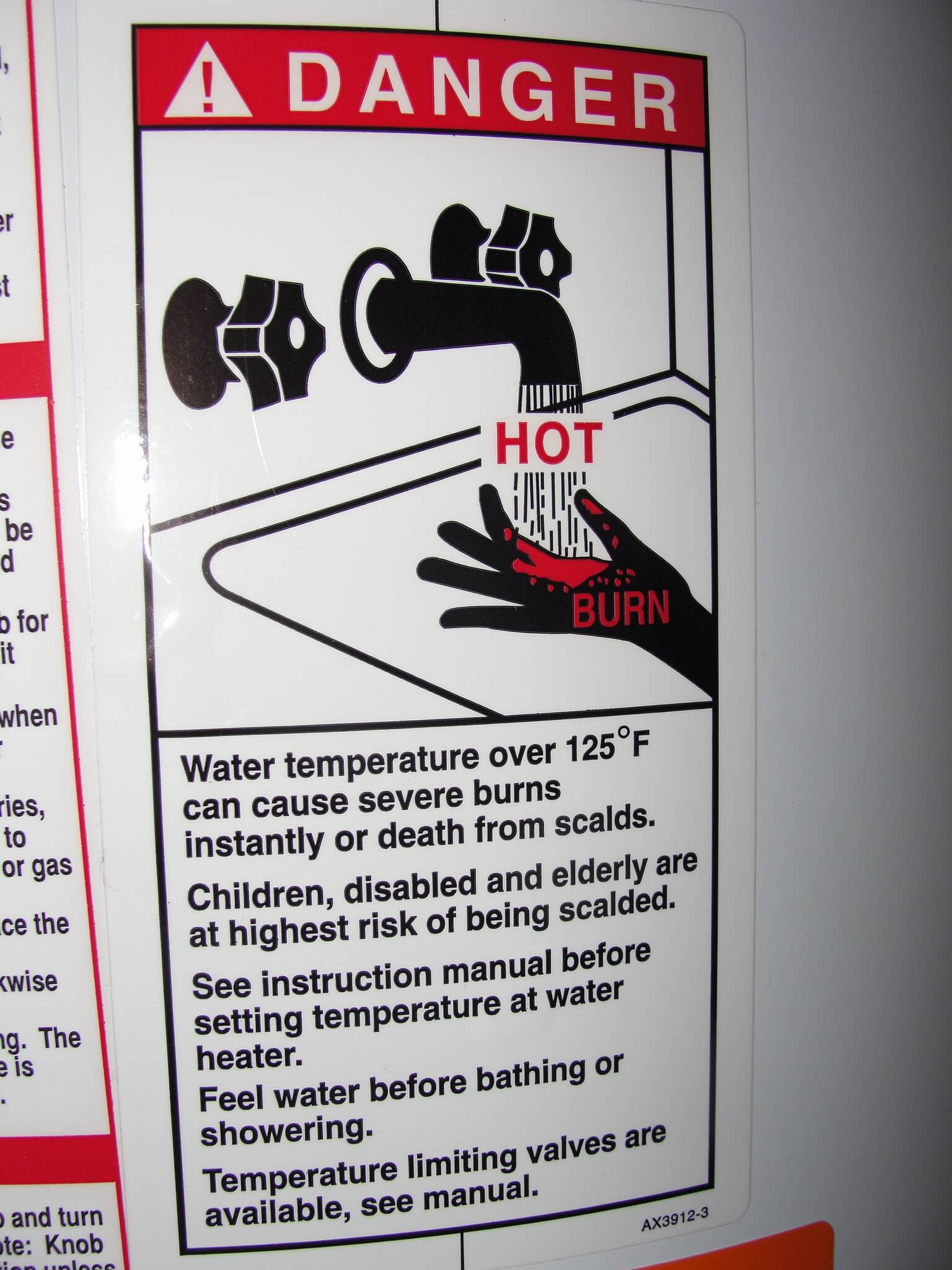
On the side of most water heaters you'll find a warning that says water temperatures of 125 degrees Fahrenheit can cause burns or death.  To be safe, the water coming out of the plumbing fixtures in a home shouldn't be any hotter than 120 degrees.   The handy photo below (courtesy of Charles Buell)  shows how fast second and third degree burns can happen at temperatures that any new water heater is capable of producing.
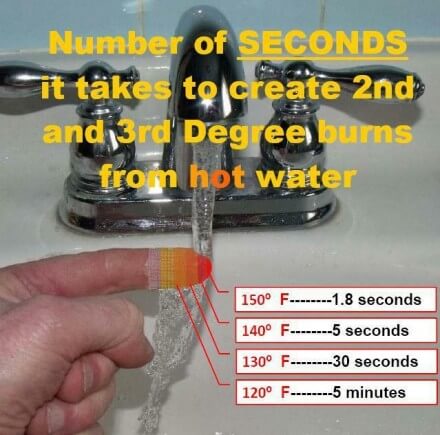
Water Temperatures

Just turning down the temperature at your water heater until you're at a safe 120 degrees isn't enough to solve potential scald hazards because the thermostat on a water heater isn't designed to keep the water at a constant temperature; it's just designed to keep the water within a certain range of temperatures.  Seattle home inspector Charles Buell has posted a couple different blogs explaining how this works - one explaining how water heaters sometimes run out of hot water faster than they should, and another on the different temperatures that will be produced by a water heater during different stages of the heating cycle.

During a recent inspection of a large home that was heated with two high-efficiency water heaters, I found quite a range in temperatures.  When I first turned the hot water on at a fixture, the water temperature started out cool; this was because the water in the hot water pipe had cooled down to room temperature.  As the hot water from the top of the tank arrived at the plumbing fixtures, the water temperature rapidly jumped up to nearly 154 degrees - this was hot enough to cause first degree burns instantaneously, and second degree burns within one second.
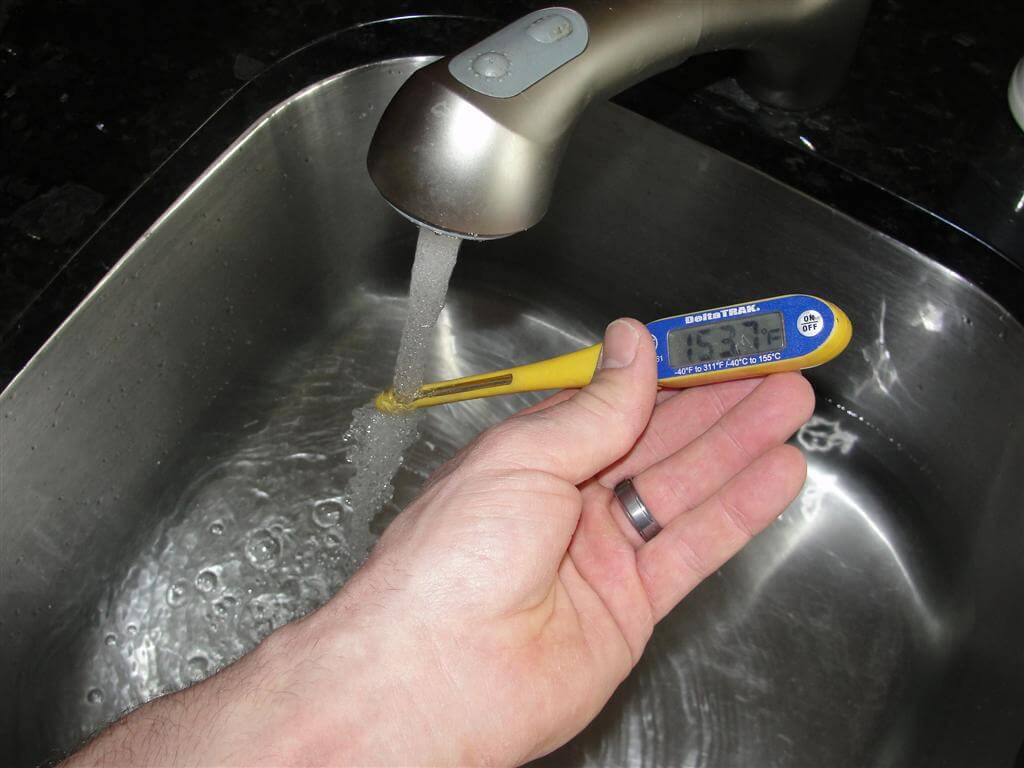
Dangerously hot water

The water only stayed at this temperature for a few seconds; it quickly dropped back down to about 135.  While there was a tempering valve installed to mix cold water in with the hot water right at the water heater outlet, it wasn't enough to completely control the water temperature at the fixtures.

Minnesota has no requirements for residential water temperatures.  Anti-scald devices are required in all new or remodeled showers or shower-bath combos in Minnesota (4715.1380 Subp. 5), but this does nothing to address the final temperature of the water coming out of a fixture.   Anti-scald devices only help to prevent people from getting scalded by a sudden swing in temperature while taking a shower.  With old shower valves that didn't have the anti-scald feature, if a toilet would flush while someone was taking a shower the pressure on the cold water line would drop, quickly increasing the water temperature at the shower.

Lower Temperatures Allow Bacteria Growth

It seems as though the solution to help prevent accidental scalding would be to turn down the temperature at the water heater to say, 115 degrees, but lower temperatures actually create other problems.

At temperatures below 135 to 140, Legionellae bacteria, which is responsible for Legionnaires' Disease, can survive and even multiply in the water heater tank.  Estimates by LegionellaPrevention.org say that up to 600,000 cases of Legionnaires' Disease are misdiagnosed as pnemonia each year, because this is something that isn't tested for in hospitals.   The diagram below shows the time it takes to kill Legionellae Bacteria at different temperatures.

To help prevent bacteria growth, the ASSE recommends keeping the water in your water heater tank at about 135 - 140 degrees Fahrenheit.
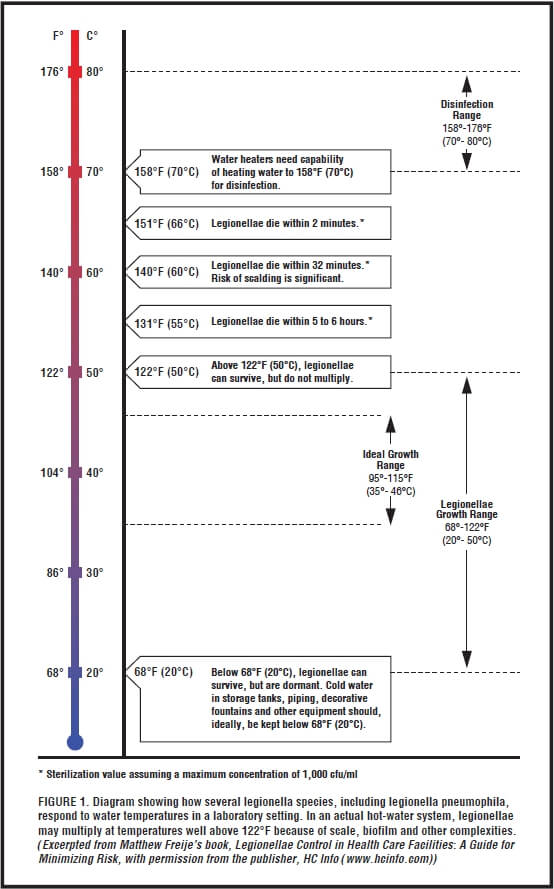
Water Temp Effects on Legionellae

Of course, this creates a scalding hazard.

So What's the Answer?

To help prevent bacteria growth and to lower the risk of scalding, have a plumber install a tempering valve and crank up the temperature at your water heater to about 135 - 140, as ASSE recommends.  Last year I wrote about how I installed a tempering valve on the hot water outlet at my own house in order to get more water out of my water heater.  These valves would be a good thing to install in every home.  A tempering valve allows you to keep the water at a dangerously high, Legionellae-killing-temperature inside the water heater tank, yet it mixes cold water in with the hot water right at the outlet, making it so you don't get this hot water at the rest of the fixtures in your home.
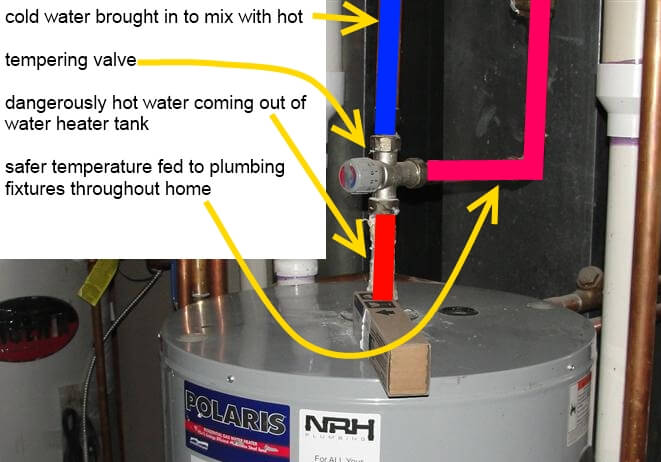
Tempering valve function

As I mentioned in my story about the recent inspection with dangerously hot water, a tempering valve won't guarantee safe water temperatures, but it will get you a lot closer.

Reuben Saltzman, Structure Tech Home Inspections


Post is included in group: Ask the Home Inspector
Post is included in group: ASHI
Post is included in group: Minnesota Real Estate Investor Group
Post is included in group: Minnesota Real Estate
Post is included in group: Professional Home Inspectors

55 Comments on There is no perfect temperature for your water heater

20 Most Recent Comments Displayed Show All

APR
18
2012
973,584 Points 349 Featured Posts Attended Rain Camp Called Shot Master

Often when houses are vacant for a period of time, the water in the tank smells bad.  Particularly so on well water-fed heaters.  This is great info!  I tell people about 130F and that a tempering valve is always a good thing.  Few listen.

Great blog Reubs!

3:13am • #36
227,118 Points 86 Featured Posts

Jay - I know exactly the smell you're talking about.  Yucky.

Shesh - you make a very convincing argument, and you bring up many valid points - especially the first one (stupid!!!!).  I'll have to let those folks over at ASSE know that they got this one all wrong, and there's probably no such thing as Legionella.

Perhaps you're right, and we're becoming a "sociaty of dumbies."

5:18pm • #37
APR
19
2012
973,584 Points 349 Featured Posts Attended Rain Camp Called Shot Master

I resisted the temptation Reubs to say anything about that last comment, since it is your post.  As tongue in cheek and sarcastic as you know I like to be on some posts, even I would have had a hard time coming up with a comment that, um, creative!

There are so many grammatical and spelling errors it would make the NEA proud (the true NEA goal - dumb them down...).

I was in a house the other day that was obviously kid central.  It appeared that must be why the people were selling - no room!  The water temp at the kitchen sink was 187F!  I had to leave the sellers a note.  Perhaps not my purview to do that, but I was concerned for everyone there. 

12:38am • #38
973,584 Points 349 Featured Posts Attended Rain Camp Called Shot Master

Oh, where did you get that chart?  Is it copyrighted or can I swipe it and use it?  It's got a good credit, so the author probably wouldn't be too upset if I was to include it in my reports, or a link to it.

12:40am • #39
227,118 Points 86 Featured Posts

Jay - It's hard not to leave a creative comment when you get an anonymous comment like that, isn't it?  For future reference, I'm definitely not 'touchy'.  Comment away :)

I heisted that chart off the white paper from the ASSE that I linked to - http://www.asse-plumbing.org/WaterHeaterScaldHazards.pdf .  

2:46am • #40
973,584 Points 349 Featured Posts Attended Rain Camp Called Shot Master

I know you're not touchy!  I tease you as much as I do anybody.  I just thought you deserved the opportunity to comment on it first!

3:13am • #41
567,531 Points 140 Featured Posts Outside Blog Called Shot Master

Reubs, I have a new Burnham high efficiency boiler with an indirect water heater. My gas bill, I just converted, all winter was around $115 a month. Still have to wait and see how much just hot water will be during the warm months. And for the record I wasn't whining, I'm just being cheap ;)

4:15am • #42
119,666 Points 1 Featured Post Outside Blog

Always informative! I knew about the scald hazard but the Legionnaires' Disease aspect I don't think I had ever encountered before.

Is it cowardliness that makes most flamers anonymous?

3:35pm • #43
APR
20
2012
227,118 Points 86 Featured Posts

Thanks Jay :)

James - yeah, I figured :).  I'll stay tuned to hear what your water heating costs are.

Marshall - Thanks.  As for the flamers, it's either cowardliness or they're a part of the sociaty (sic) of dumbies (sic) ;).


3:02am • #44
152,188 Points 14 Featured Posts

Great tips. Thanks!

4:52am • #45
125,621 Points 4 Featured Posts Outside Blog

What an informative and well written blog. Thanks for the education!

10:46am • #46
292,852 Points 3 Featured Posts Outside Blog Attended Rain Camp

Wow, you always hit such interesting topics! I never thought about the temperature of a water heater, but will now!

3:49pm • #47
153,008 Points Outside Blog

GREAT info. I just got a new heter a few months ago and need to chck it out, and put the temepring valve on it!

THANKS!!

7:44pm • #48
APR
21
2012
496,545 Points 13 Featured Posts Outside Blog Called Shot Master

Hi Reuben, excellent post and really enjoyed the graphics.  Thanks for sharing.

4:53am • #49
419,779 Points 15 Featured Posts Called Shot Master

Reuben, thank you for the valuable information, one more thing to watch for in my rentals.

3:40pm • #50

Reuben - great information, thank you for sharing, got a temperature valve at my new unit.

7:07pm • #51
APR
22
2012
700,921 Points 39 Featured Posts Outside Blog Called Shot Master

Wow, never knew about the Legionaire's stuff & temperature. Thanks for the helpful info.

5:52am • #52

I just learned a lot. thank you.

3:18pm • #53
APR
23
2012
Outside Blog Attended Rain Camp

Great information.  Didn't know this.  Thanks so much for sharing.

1:15pm • #54
APR
24
2012

Great Post! Another area of concern is old gate valves on tankless coils or lack of mixing valve on tankless coils. We also stress insulating all of the hot water piping. When this is done, the temperatures need to be re-measured as several degrees can be gained from the insulation!

5:09am • #55

20 Most Recent Comments Displayed Show All


What does the graphic say?
Leave a response…


(optional)
Spam Prevention: