What is a short sale?  When giving lectures I like to use the definition as follows:

The sale of a real estate property for a price that is less than the total amount necessary to fully satisfy the actual present encumbrance (mortgage) indebtedness on the real estate property.

Often I see a different description, one that says, The sale of real estate when the lender accepts less than its mortgage amount and forgives borrower from paying the deficiency.

Which is correct?  A look at the short sale acceptance letters lender's provide is going to tell us the real truth about short sales and forgiveness of deficiencies.  This article will discuss examples of short sale acceptance letters.  Read carefully, as you will probably be surprised!

Before going on, it is important that you have read and understood the concept of a promissory note and of a mortgage which secures the promissory note.  See my article which explains it at A LAWYER'S EXPLANATION OF THE FORECLOSURE PROCESS.

Here is Example #1 of a short sale acceptance letter:

ASC Acceptance Letter


You will notice that the letter says this is an acceptance of a short sale.  It says if all the things in 1 thru 5 are done the mortgage will be discharged and a release document will be provided to be recorded and the foreclosure dismissed.  There is no mention of any cancellation of the promissory note.  In this example there is no forgiveness of any deficiency.

See this next example from Bank of America the language is different.

BAnk Of America Letter

Here, the letter says the deficiency balance will be reported to credit bureaus as "charge off" and the liability for the deficiency balance is "to be determined".  This is confusing but what it means is that (1) there is a deficiency and (2) the lender will later determine what to do about the deficiency.

Next, is a 2 page letter from Countrywide.

Countrywide Short Sale page 1

Countrywide Short Sale Letter page 2

This letter is the most definitive from the three presented.  At paragraph 9 it clearly states that there is no promissory note required from the borrower.  When taken with paragraph 13, it is clear that Countrywide will not pursue a deficiency judgment if the short sale closes.  Thus in the example presented there is no deficiency that will be collected.

This last example from Chase was not as simple.
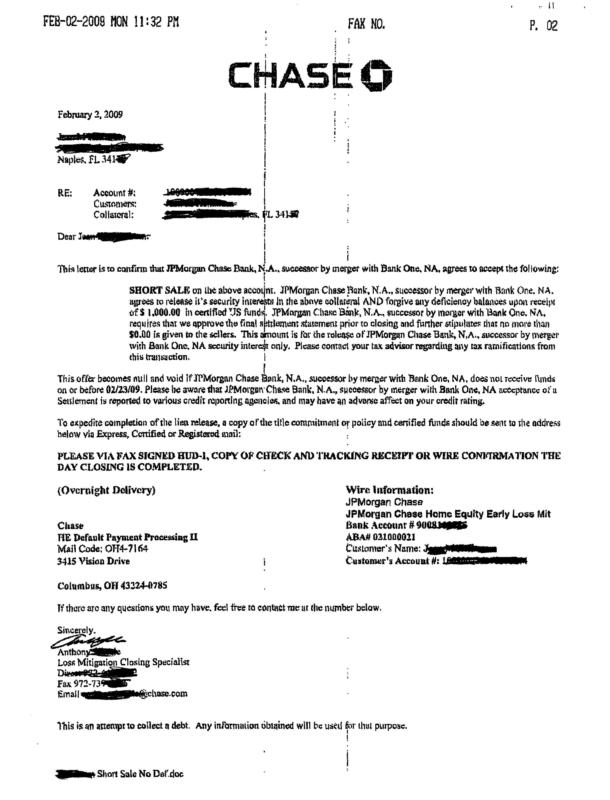
Chase Short Sale Letter

Here it says that Chase will release its security interest (the mortgage) and forgive any deficiency balance but then says that the payment of $1,000 is only for the release of the security interest only.  This I would understand to mean the mortgage and not the promissory note.  At the bottom of the page (but not part of the letter) is a notation "Short Sale No Def.doc".  So I sent an email to Chase about this discrepancy and they confirmed - in writing - that it was a waiver of any deficiency.

Be very careful where you see language like "release and satisfaction" of the mortgage.  What about the promissory note?  That language almost always means that the lender is NOT giving a forgiveness of the financial obligation and has the option to pursue the deficiency for years to come. See FORECLOSURE DEFICIENCY JUDGMENT or SHORT SALE PROMISSORY NOTE or BANKRUPTCY - REVISITED.

In summary, it is most important that you read and question the short sale approval letter you get.  A "release and satisfaction" of a mortgage is NOT necessarily a cancellation of the promissory note (forgiveness of deficiency).  The letter from the lender should be clear and unequivocal and not subject to supposition or interpretation.  If you are uncertain, don't be bashful - ask the lender for clarification and get it in writing!

Copyright 2009 Richard P. Zaretsky, Esq.

Be sure to contact your own attorney for your state laws, and always consult your own attorney on any legal decision you need to make.  This article is for information purposes and is not specific advice to any one reader.

Richard Zaretsky, Esq., RICHARD P. ZARETSKY P.A. ATTORNEYS AT LAW, 1655 PALM BEACH LAKES BLVD, SUITE 900, WEST PALM BEACH, FLORIDA 33401, PHONE 561 689 6660  RPZ99@Florida-Counsel.com - FLORIDA BAR BOARD CERTIFIED IN REAL ESTATE LAW - We assist Brokers and Sellers with Short Sales and Modifications and Consult with Brokers and Sellers Nationwide!  Shortsales@Florida-Counsel.com  New Website www.Florida-Counsel.com.  See our easy to find articles at Need Short Sale Information? - These Articles Probably Answer Your Question


 
This post has been included in Florida Information
Post is included in group: Short Sale Specialists & Pre-Foreclosure Education
Post is included in group: Short Sale REALTORS®
Post is included in group: Realtors®
Post is included in group: PALM BEACH COUNTY SHORT SALES
Post is included in group: Florida Realtor® Network

15 Comments on LENDER SHORT SALE ACCEPTANCE LETTER EXAMPLES - READ WITH CAUTION!

FEB
04
202,482 Points 19 Featured Posts Outside Blog

Richard,

Thank you. I'm printing this to read entirely, I think everyone should.

I may be back.

Bill

8:27am • #1

I appreciate the insight into short sales.  Would be intereseted to know if short sales vary from state to state or is this the same all across the board?

8:37am • #2

RICHARD,

It's good to point out that many of those letter are "stock" letters and there needs to be negotiations to try andhave the wording protect the seller from later consequences. I have found that lenders are more amendable for primary residences but steadfast with the second or investment property.

Become a CDPE Today

Schedule Your Class

5:13pm • #3
157,692 Points 9 Featured Posts Outside Blog

Richard - Those are great examples.   What would you suggest when there is an open-ended potential to seek the deficiency, like BOFA example?  Am I correct in thinking the seller should just accept, as their only alternative might be bankruptcy, especially in cases where deed-in-lieu in not possible?  Thank you for any edification.

6:20pm • #4
FEB
09
132,206 Points

Richard...thanks for sharing the different scenarios.  I'll stick around for additional comments.

6:29am • #5
MAR
02

Very informative comment, I think many people involved in the short sale process, from realtors to borrowers to attorneys, do not focus enough on the elimination or reduction of the deficiency.  This is especially true in those states where a deficiency is minimized or not available, and in the short sale process the borrower may be exposing themselves to a deficiency the lender could not obtain in a foreclosure.

Paul
8:42am • #6

PAUL,

A deficiency in a foreclosure is often greater than in a Short Sale because the lenders include all the expenses associated with the foreclosure and subsequent sale, including court costs, lawyer fees, real estate commissions, ect...ect.

2:48pm • #7
MAR
26

I wanted to know if you have an example of the financial statement that my mortgage company is asking for to prove that we need to short sale our property.  I have the hardship letter pretty much done but I don't know anything about the financial statement part.  We already have a buyer to I need to get this done pretty quick.  If you don't know, could you refer me to a place/person that might?  This is a very stressfull thing we are doing but we are both in the auto industry and have taken a major hit on our credit.  Thanking you in advance.

Laura Tucker

Laura Tucker
4:37pm • #8

LAURA,

You can call me for the form.

4:57pm • #9
JUN
20

Sir, I am in a big mess our business property is being sold for short sale. Mortgage amount of 3.3 mil going to be sold for approx 1 mil how will my 1099 affect me, when I don't have money to pay bills and now I will have to pay a huge amount to IRS????

Can you please advice asap. I am in Alabama.

Mina

mina
7:20pm • #10
JUN
23
5 Featured Posts

Mina

You are in one of the few instances where a bankruptcy should be examined rather than a short sale or loan modification.

Here is the problem from your brief description:  You cannot pay the deficiency, even over time (so you say) and you cannot pay the income tax (also over time since the IRS can make term payments available to you).  IF you simply cannot deal with the forgiveness of debt (the 1099C) then you need to avoid it.  There are only 2 ways to avoid the 1099C -- pay the deficiency or sign a promissory note or agree to continue paying on the existing note, or file bankruptcy BEFORE the short sale.

Timing is critical.  You must consult with a tax or bankruptcy attorney or both immediately!

6:20am • #11
157,692 Points 9 Featured Posts Outside Blog

Richard - It is my understanding that bankruptcy will only delay foreclosures, not prevent them, unless there is a repayment plan-type bankrupcty like Chapter 13, and the borrower is able to make payments, correct?  The bankrupcty court is not interesting in taking an asset with negative equity- is that right?  Thank you for clarifying.

8:18am • #12
5 Featured Posts

Wendy -

Bankruptcy in a chapter 7 liquidation will not permanently stop a foreclosure but it will delay it - for 30 or 60 days.  If the borrower wants to keep the house out of foreclosure then the payments must be timely made.

A Chapter 13 bankruptcy could allow the 2nd mortgage to be reduced as to SECURED principal and the balance would become a general creditor debt. The mortgages must be kept current to prevent a foreclosure.

In both situations the borrower is relieved from personal obligation for any deficiency so the loans become non-recourse. 

11:44am • #13
OCT
14

Richard,


I have recieved the Bank of America letter and don't know what to do. What's the point of doing the short sale if BOFA retains the right to come after me for the deficiency at a later date?  By me signing the note it gives BOFA 6 years to come after me for the deficeny. Basically, they're saying we'll let you sell the house, but we won't forget the debt.  Also, the MI company wants me to sign a seperate 25K note!

This being my primary home, it seems better for me to foreclose and take my chances because in NV the lender only has 6 months to sue me for the deficiency from the date of the sale.


Please advise.

Arun Dev
8:30pm • #14
OCT
23
5 Featured Posts

Arun

I am not familiar with the laws of Nevada - but you need to consider 2 laws, not just one.

The first law is the matter of the deficiency IN the foreclosure sale - that is the law you refer to.

The second law is the unpaid portion of the promissory note.  That can be brought as a separate breach of contract action and a separate and longer right to sue (statute of limitations) is used for that right of action.  The start point for that statute of limitation would likely be the date you were declared in default of the promissory note.  You need to determine the time limit on that possible action as well.

Lastly, under both scenarios you will likely have a "second bite of the apple" - meaning you will have other opportunities to negotiate a settlement on the balance of that unpaid balance.  Understand though that a judgment that carries a statory interest rate every year is far more valuable to a holder of that judgment than a non-interest bearing promissory note they are offering to you now. (Be sure it has no interest as that makes it far less valuable to the holder because of something called Net Present Value).

5:06am • #15

Leave a response…


(optional)
What does the graphic say?
 
Rainmaker_large

Richard Zaretsky, Florida Real Estate Attorney

West Palm Beach, FL

More about me…

Richard P. Zaretsky P.A.

Address: 1655 Palm Beach Lakes Blvd, Suite 900, West Palm Beach, Fl, 33401

Office Phone: (561) 689-6660 x 107

Email Me

Legal true life experiences, general observations and commentaries for Realtors, Lawyers and Mortgage Brokers - also see our Palm Beach County Short Sales group blog.


Links

Archives

RSS 2.0 Feed for this blog

Find FL real estate agents and West Palm Beach real estate on ActiveRain.