
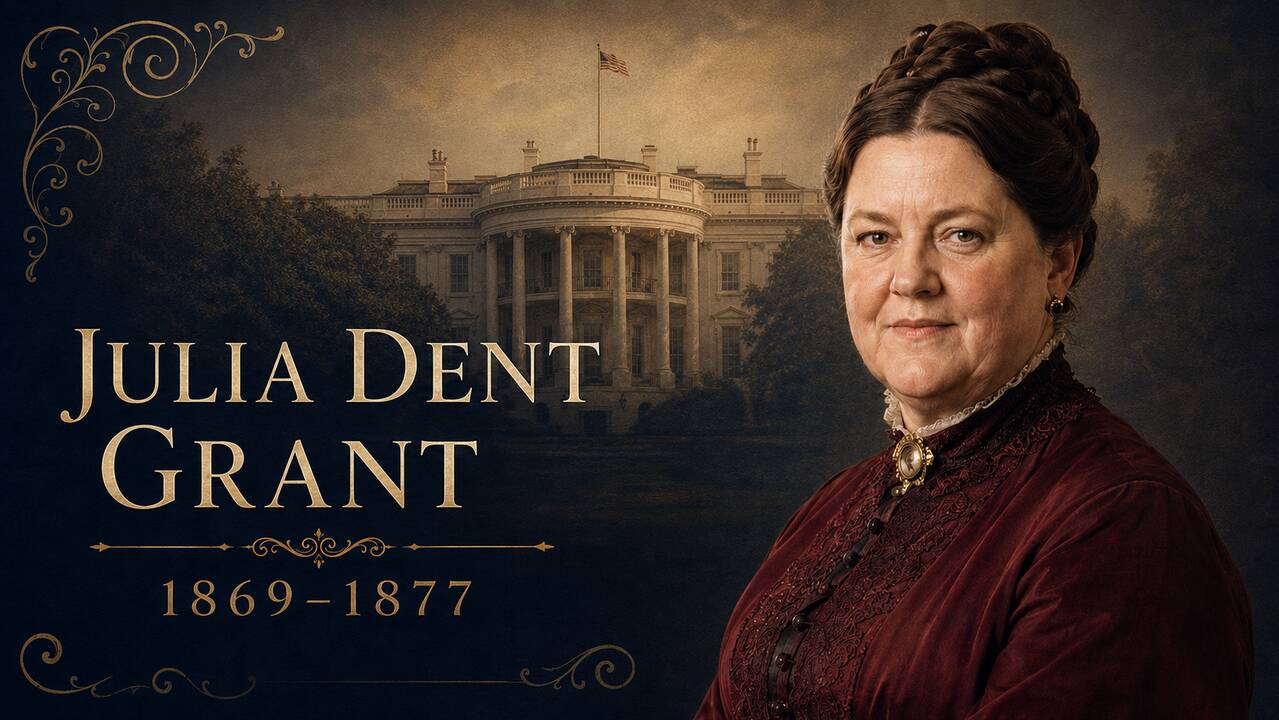
“For nearly thirty-seven years, I, his wife, rested and was warmed in the sunlight of his loyal love.” -Julia Grant
Born: January 26, 1826 (St. Louis, Missouri, USA)
Died: December 14, 1902 (Washington, D.C., USA)
Years as First Lady: March 4, 1869 – March 4, 1877
Julia Dent Grant, the wife of President Ulysses S. Grant, entered the White House after years of separation, war, and financial hardship. Unlike some First Ladies who found public life burdensome, Julia embraced her role with enthusiasm. She enjoyed entertaining, welcomed the attention that accompanied her husband’s presidency, and later remembered their eight years in the White House as among the happiest of her life.
Julia was born near St. Louis, Missouri, and grew up at White Haven, her family’s plantation. She was one of seven children born to Frederick and Ellen Dent. From the age of ten until seventeen, she attended a boarding school in St. Louis, where she studied literature, history, philosophy, and other subjects considered appropriate for a well-educated young woman.
Julia’s comfortable childhood was made possible in part by the labor of enslaved people. Slavery was deeply woven into life at White Haven, and Julia continued to hold favorable memories of the plantation long after the Civil War. This remains one of the more troubling and complicated parts of her story. Her husband’s family opposed slavery, while Julia’s father was a committed slaveholder, creating tension between the Dent and Grant families.
 Julia met Ulysses S. Grant in 1844 when he visited White Haven with her brother Fred, who had been Grant's roommate at West Point. The young lieutenant quickly became a frequent visitor, joining Julia for walks and horseback rides. Their courtship led to one of the sweetest proposal stories associated with any presidential couple.
While traveling together to a wedding, they came to a rain-swollen creek. Julia nervously told Ulysses that if anything happened, she would cling to him no matter what he said. After guiding their carriage safely across, he asked whether she would cling to him for the rest of her life.
They became engaged, but the Mexican-American War delayed their marriage for four years. During their long separation, Ulysses wrote Julia affectionate letters describing how much he missed her. They were finally married on August 22, 1848, at her family home in St. Louis.
The early years of their marriage were far from easy. Ulysses’ military assignments took them to several remote locations, and there were long periods of separation. After he resigned from the Army in 1854, the family struggled financially. Grant attempted farming and several other occupations before eventually moving his wife and children to Galena, Illinois, where he worked in his father’s leather goods business.
The Grants had four children: Frederick, Ulysses Jr., who was known as Buck, Ellen, called Nellie, and Jesse. Julia was a devoted mother, while Ulysses was known to be a loving father. The close-knit family would remain a source of strength to both of them throughout their lives. We've heard a lot of stories about the high infant mortality rates in those days, but all four of the Grant children lived long lives, outliving both parents.
When the Civil War began, Ulysses returned to military service and quickly rose through the ranks. Julia joined him whenever conditions permitted, sometimes even traveling with their children to military camps near the fighting.
Julia had lived since childhood with strabismus, a condition that caused her eyes to appear crossed. As her husband became more famous, she considered corrective surgery because she worried about how she would look in public. Ulysses discouraged her, reminding Julia that he had seen those same eyes when he fell in love with her and liked them just as they were. His tender reassurance reflected the warmth and devotion that defined their marriage.
Julia was delighted when Grant was elected president in 1868. After years of hardship, she enjoyed the elegance, excitement, and social life of the White House. She hosted receptions, dinners, musical events, and gatherings for foreign dignitaries, politicians, military officers, and their families. Her natural warmth helped create a more relaxed and welcoming atmosphere.
 During the Grant administration, the White House became the setting for several memorable occasions. Julia presided over the first White House state dinner held for a reigning monarch when King Kalakaua of Hawaii visited in 1874. That same year, the East Room was transformed for the elaborate wedding of the Grant's daughter Nellie. The Grants also oversaw extensive redecorating, adding new furnishings and gas chandeliers suited to the increasingly formal style of the times.
Julia was an influential presidential wife, although much of her influence was done privately. She discussed appointments, political personalities, and important decisions with her husband. She also supported efforts to improve women's public standing and hosted suffragists at the White House, though she did not become an outspoken advocate for women’s suffrage herself.
When Grant’s second term ended in 1877, Julia was very sad to leave the White House. However, she and her husband soon began an extraordinary journey around the world. For more than two years, they traveled through Europe, the Middle East, India, China, and Japan.
The years that followed brought both happiness and heartbreak. A failed investment scheme left the Grants nearly penniless. Soon afterward, Ulysses was diagnosed with throat cancer. Knowing his time was limited, he worked tirelessly to complete his memoirs so the proceeds would provide financial security for Julia and their family.
When he died on July 23, 1885, their marriage had lasted nearly thirty-seven years. His memoirs became an enormous success and restored the family’s financial security, fulfilling his final goal of providing for the woman he had loved since their courtship.
In her later years, Julia began writing her own memoir. She wanted to preserve her family's story and offer her perspective on the man we knew as a famous general and president. Her writing also helped ease her loneliness after Ulysses’ death. She completed the manuscript during the 1890s, but it was not published during her lifetime. The Personal Memoirs of Julia Dent Grant was finally published in 1975. Since the book was published so long after Julia's death, I was curious to know who was receiving the royalties from the book, but wasn't able to get a definitive answer.
Julia died in Washington, D.C., on December 14, 1902, at the age of 76. She was laid to rest beside her husband in the General Grant National Memorial, better known as Grant’s Tomb, in New York City.
Fun Fact:
Julia Grant was the first First Lady known to have written a complete memoir. It is unfortunate that it wasn't published during her lifetime, and that she never received any proceeds from book sales.


Comments(12)