
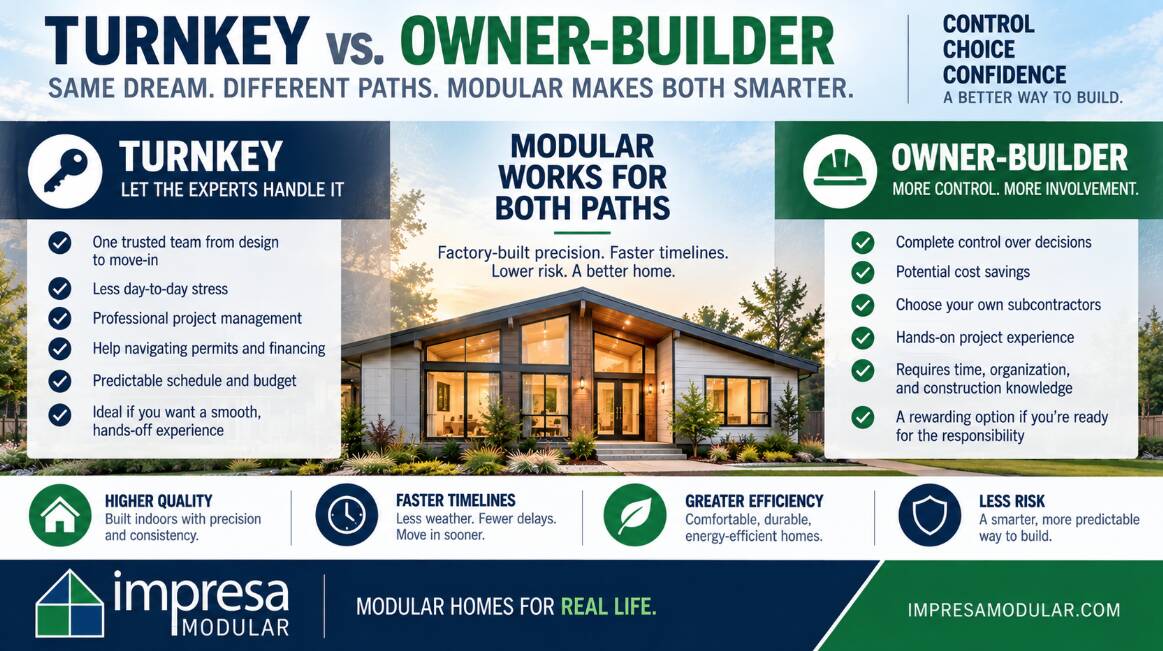
Building a custom home comes with a decision most buyers underestimate: how much of the construction process do you want to own yourself?
Some buyers want a turnkey experience. They want a professional builder to coordinate the schedule, manage subcontractors, solve problems, and carry responsibility for execution. Others are comfortable acting as an owner-builder because they want more control over decisions, costs, and the people performing the work.
Neither choice is automatically right. The real question is whether the project structure matches your experience, time, financing, risk tolerance, and appetite for managing dozens of moving parts.
Turnkey: Paying for Coordination and Accountability
A turnkey builder is not just selling labor. You are paying for coordination, sequencing, trade management, problem solving, schedule control, and accountability. That value becomes clearer when you look at the full modular home building process and see how many decisions have to connect before a finished home is ready for occupancy.
Even with a professional builder, the owner still has choices to make. Plans, finishes, site decisions, financing, allowances, change requests, and timing all require participation. What changes is who carries the burden of managing the construction system when something does not go according to plan.
For many buyers, that is money well spent. A strong builder brings trade relationships, local knowledge, scheduling experience, and the ability to absorb problems without making every issue the homeowner's personal emergency.
Owner-Builder: More Control, More Responsibility
The owner-builder path can work well for the right person. Impresa's owner-builder framework is built around that reality: the homeowner can take the lead on financing, land, site work, and local construction while receiving a defined roadmap for the modular portion of the project.
The potential upside is obvious. You may avoid part of the general contractor markup, choose your own subcontractors, control purchasing decisions, and stay closer to every detail of the project.
But the savings are not automatic. If materials are ordered incorrectly, a subcontractor misses a critical sequence, site work is not ready when the modules arrive, or a scope gap appears between the factory and the field, the owner-builder owns the problem. Saving a management fee can be a poor trade if the project gives that money back through delays, rework, duplicate labor, or financing costs.
How Modular Changes the Risk Profile
This is where modular construction can materially change the owner-builder equation. Compared with conventional site-built construction, factory-built modular shifts a large share of the home's construction into a controlled production environment while site preparation and foundation work can proceed in parallel.
That does not eliminate the need for project management. It reduces the amount of work that must be coordinated on the lot and compresses the period during which weather, trade availability, material exposure, and jobsite sequencing can disrupt the project.
The key is understanding exactly where the factory scope ends and the site scope begins. A buyer who understands the division of responsibility can use modular to simplify the field operation. A buyer who assumes the factory is delivering a completely finished turnkey home may discover expensive gaps at the worst possible time. That is why a clear process map matters more than the label 'owner-builder.'
Financing May Decide the Structure Before You Do
The biggest practical constraint for some owner-builders is financing. Modular projects commonly use construction-to-permanent financing with milestone-based draws, and lenders need to understand how factory deposits, module completion, site work, set day, and final completion fit together.
Lenders also differ on whether they will allow the homeowner to serve as the general contractor. Impresa's construction-loan guidance for modular buyers notes that some lenders permit owner-builders while others may require a professional building consultant or general contractor to be involved.
That means the owner-builder decision should not be made in isolation. Talk with the lender early, before you commit to a project structure that the financing will not support.
The Better Question Is Not “Which Is Cheaper?”
The original turnkey-versus-owner-builder comparison remains useful because the tradeoff is still the same: turnkey buys management and risk transfer, while owner-builder preserves control and may reduce cost if the homeowner can manage the work effectively.
The better question is not simply, 'Which option costs less?' It is, 'Which structure gives this specific project the best chance of finishing on time, on budget, and at the quality level I expect?'
For some buyers, the answer will be a full-service builder. For others, it will be an owner-builder model with modular construction doing much of the heavy lifting offsite. And for many, the strongest answer may sit somewhere in between: homeowner control supported by experienced professionals where the risk is greatest.
If you were building your next home, would you rather pay more for turnkey accountability or take on more responsibility to preserve control and potential savings?
Do More With Modular!®



Comments(5)