
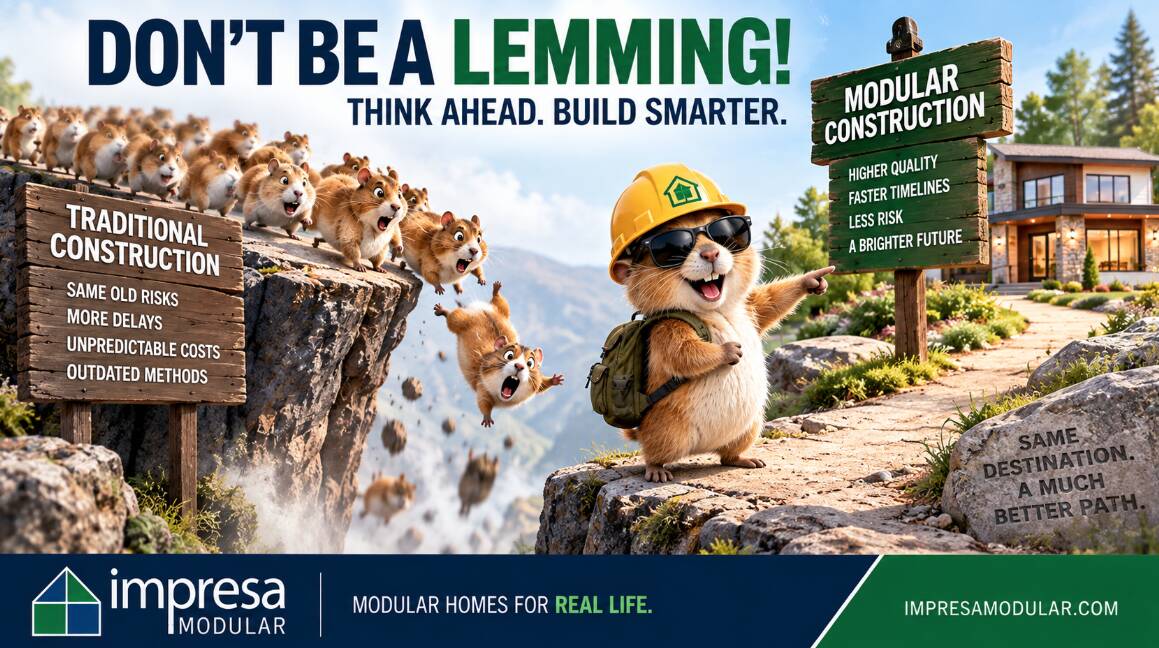
The old story about lemmings blindly following one another over a cliff is a myth, but the metaphor survived for a reason. It captures what happens when people keep following a familiar path without stopping to ask whether a better one exists. Home construction deserves that same challenge.
For generations, most homes have been assembled outdoors, one project at a time. That approach can produce excellent homes. But familiarity should not exempt any production system from comparison. When buyers are choosing how to build, they should understand the real differences between modular and site-built construction, including schedule, quality control, site constraints, price predictability, and design tradeoffs.
Off-Site Construction Is Not New
Off-site construction simply means that part of the building is produced somewhere other than its permanent site. We already accept this throughout residential construction. Windows, doors, roof trusses, floor systems, cabinets, structural components, and many other elements are manufactured away from the jobsite because controlled production can improve consistency and efficiency.
That evolution continues with panelization, component manufacturing, and modular construction. The important question is not whether something was built off-site. The better question is whether moving that work into a controlled production environment improves the finished building. Impresa’s overview of off-site construction systems shows how panelized, modular, and other systems move different amounts of work away from the site.
Modular Moves More of the Building Into Production
With panelized construction, walls, floors, or roof sections may be produced off-site and then assembled at the project location. Modular construction moves farther along that spectrum. Finished three-dimensional sections are built indoors, transported to the site, and installed on a permanent foundation. The modular construction process concentrates much more of the work in a factory environment before the home reaches the lot.
Inside the factory, the house moves through defined stages while specialized crews repeat tasks, materials remain protected, and quality checks occur throughout production. A current step-by-step look at how modular homes are built in the factory makes the distinction clear: the advantage is not simply putting a roof over construction. It is organizing construction around a repeatable production system.
The Real Issue Is Risk and Predictability
Site-built construction still makes sense for many projects, especially when access is tight, geometry is unusual, or local conditions favor field construction. But it also exposes more of the building process to weather, site logistics, subcontractor availability, material handling, and sequential trade coordination.
Modular does not eliminate risk. It changes where risk is managed. More decisions happen earlier. Transportation and crane access matter. Factory capacity matters. Site readiness matters. But the controlled process can reduce certain forms of variability while allowing site work and factory production to proceed in parallel. That is why resilient modular construction is less about claiming one building system is universally superior and more about designing strength, consistency, and repeatability into the delivery process.
Do Not Confuse Tradition With Optimization
The strongest argument for modular is not that conventional construction is bad. That is too simplistic. The argument is that construction should keep evolving. We accepted factory-built windows. We accepted roof trusses. We accepted engineered components because they solved real production problems. Housing should be evaluated with the same discipline.
The future will likely use multiple building systems, often in combination. The companies that perform best will understand where each system creates value and how to coordinate them. That is the point behind harnessing the power of off-site construction: use the right production method for the right part of the building instead of defending one method simply because it is familiar.
So do not follow the herd. Ask better questions. Where should the work happen? Which risks can be controlled earlier? Which system gives the project the best combination of design, quality, schedule, cost, resilience, and predictability?
Do More With Modular!®


Comments(2)