
Summer is done, just look at your trees leaves, they are getting less sunlight, fading chlorophyll, schools are back, Labor Day is done, football season is upon us and look in your grocery store and see the Halloween candy is already tempting you.
I know, I know, many of you in the south don't experience what we do above the Mason-Dixon line, but you might get an ice snap or those surges of darn tourists and snow birds that hate the heat but like the warmth will be upon you. (that's your penance.)
I know we've got a good couple of months yet, but plan and act early and you'll even have time to put up your holiday decorations without being nipped by ole man frost.
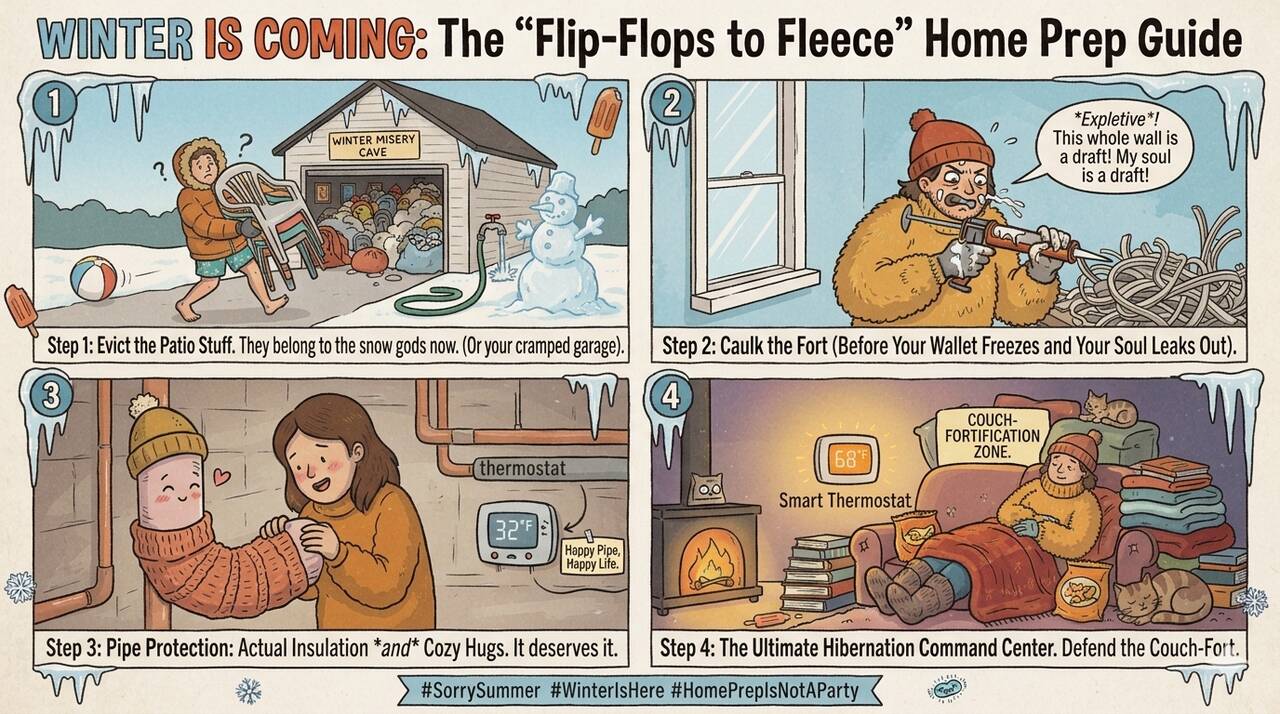
Step 1: The Great Patio Furniture Evacuation
It happens every year. One day you’re enjoying an iced coffee on the deck, and the next, you’re staring out the window at a lawn chair slowly being buried by a bleak, gray frost. Summer didn’t just leave; it packed its bags and ghosted us. Now, it’s time to face the music—and by music, I mean the freezing wind.
Your first mission in the war against winter is to clear the deck. Literally.
If you leave your garden hose hooked up to the outdoor spigot over winter, the water inside will freeze. When water freezes, it expands. When it expands inside a copper pipe hidden inside your warm walls, it bursts. You won’t realize this happened until spring when you turn the faucet on and accidentally create an indoor swimming pool in your basement.
The Fix: Disconnect the hoses, drain them completely, and roll them up. If you have interior shut-off valves for your outdoor spigots, turn them off and drain the spigot.
Patio Furniture Exiled to the Snow Gods
We’ve all seen that one neighbor who leaves their plastic lawn chairs out all winter. By February, those chairs aren’t seating options; they are brittle, sad ice sculptures. Unless you want your expensive patio set to look like a prop from an apocalyptic wasteland movie, you need to store it.
The Fix: Wipe down your furniture, stack the chairs, and cram them into the garage, basement, or shed. If you are entirely out of space because your garage is already a "misery cave" of unfinished DIY projects, invest in heavy-duty, waterproof furniture covers and strap them down tightly. Otherwise, they belong to the snow gods now.

The Gutter Apocalypse
Before the ground freezes solid, look up. Your gutters are likely choked with a soggy, decaying soup of autumn leaves. If you leave them there, winter snow will melt, hit that leaf dam, freeze again, and form a massive block of ice known as an "ice dam." These heavy blocks can rip the gutters right off your house and send water seeping under your shingles.
The Fix: Grab a ladder, a pair of gloves, and clear out the muck. It is a disgusting, thankless job, but it is much cheaper than replacing a roof.
"2 or 3 story homes, hire the pros, let them break their legs if they fall."
Step 2: Fortifying the Castle (Stopping the Drafts)
Now that you’ve secured the perimeter outside, it’s time to seal the borders inside. Right now, there is cold air circling your house like a pack of wolves, looking for any tiny crack to squeeze through. If you don't find those cracks first, your thermostat will run non-stop, and your heating bill will look like a phone number.
The Great Draft Hunt
Before you buy any supplies, you need to find the enemy. Walk around your house on a windy day and do the "hand test." Run your hand around window frames, external door edges, and even electrical outlets. If you suddenly feel a freezing breeze that makes you question if your house is haunted, you’ve found a leak.
The Fix: For a more cinematic approach, light a stick of incense or a candle and hold it near windows and doors. Wherever the smoke dances wildly or blows horizontally, you have a draft.
Caulking Chaos vs. Weatherstripping
Once you find the leaks, you have to seal them. This is where you get to pretend you are a professional contractor, even if you have no idea what you're doing.
Windows: Grab a tube of exterior silicone caulk and run a bead along the gaps where the window frame meets the house. Pro tip: Try to keep it neat, or your windows will look like they were sealed by an angry toddler with a tube of toothpaste.
Doors: If you can see daylight through the cracks of your closed front door, you are basically heating the entire neighborhood. Apply adhesive foam weatherstripping inside the door jamb. It squishes down when the door closes, trapping the warm air inside.
The Couch-Fort Hack (For the Truly Lazy)
If you discover a massive draft under your door at 10 PM on a Sunday and you don't have weatherstripping, it's time to improvise.
The Fix: Take a bath towel, roll it up tightly into a canvas burrito, and shove it against the bottom of the door. If you want to get fancy, you can cut a pool noodle in half, wrap it in fabric, and slide it under the door. It’s not elegant, it’s not permanent, but it keeps your toes from turning into popsicles while you binge-watch TV.
Step 3: Keeping the Inside From Turning Into an Ice Rink
At this point, your house is sealed tighter than a submarine, but we still need to talk about the machinery keeping you alive. Your furnace and your plumbing are about to work a triple shift for the next five months. If you don't give them a little love now, they will retaliate by breaking down on the coldest night of the year.
The HVAC Pep Talk
Your furnace has been sitting dormant all summer, collecting dust and spiderwebs. If you just flip it on and hope for the best, it’s going to choke.
The Fix: Change your furnace filter right now. A clogged filter forces your heating system to work twice as hard, blowing your monthly energy budget out of the water. If your filter looks like a wool sweater made of gray lint, replace it. Mark your calendar to swap it out every 30 to 90 days all winter long.
The Ceiling Fan Reverse Trick
Did you know your ceiling fan has a winter mode? Most people completely forget about the tiny black switch on the side of the fan motor.
The Fix: Flip that switch so the fan blades rotate clockwise on low speed. In the summer, counterclockwise rotation creates a cooling breeze. In the winter, clockwise rotation does the exact opposite: it gently draws cool air upward, which forces the trapped, warm air near your ceiling back down to human level. It’s free heat.
Give Your Pipes Emotional (and Physical) Support
Frozen pipes are the ultimate winter horror story. When a pipe freezes and bursts, it doesn’t just cause a leak; it causes a catastrophic indoor geyser that destroys drywall, flooring, and family heirlooms.
The Fix: Head down to your basement, crawl space, or attic and locate any exposed water pipes. Wrap them up in foam pipe insulation sleeves. Think of it like putting a cozy winter coat on your plumbing. It costs a few bucks at the hardware store and takes minutes to install, but it can save you thousands of dollars in emergency plumber fees.
"Did you know finding a plumber is like finding a needle in a haystack."
Step 4: The Ultimate Hibernation Setup
Congratulations! You’ve secured the outside, sealed the drafts, and insulated the pipes. The hard manual labor is officially over. Now comes the best part of winter preparation: setting up your indoor bunker so you never have to leave until April.
The Thermostat Power Struggle
If you live with another human being, the thermostat is about to become a battleground. Someone will inevitably try to set it to 75°F and wear shorts, while someone else will insist on 62°F to "build character."
The Fix: If you haven't already, upgrade to a smart programmable thermostat. Set it to drop to a chilly 62°F (16°C) when you are asleep or at work, and crank it up to a comfortable 68°F (20°C) when you are home and conscious. It automates the savings so you can stop arguing over the control panel.
Defending the Couch-Fort
True winter readiness requires proper snack and comfort logistics. If a massive blizzard knocks the power out for a day, you don't want to be stranded without the essentials.
The Fix: Gather your survival gear. This includes a flashlight with working batteries (no, your phone flashlight doesn't count if your battery is at 12%), a heavy stash of blankets, and non-perishable snacks. Pro-tip: Make sure 90% of your emergency rations are comfort food. Pop-Tarts and chocolate chips are scientifically proven to boost morale during a power outage.
Conclusion: You Did Your Best (ish)
And there you have it. Summer is dead and buried, but your home doesn't have to freeze along with it. By taking a weekend to evict your patio furniture, slap some weatherstripping on your doors, and give your pipes a warm hug, you have officially built a fortress against the cold.
"Now hunker down, freeze safely, and let the countdown to Christmas begin—the only holiday that justifies buying 12 giant blankets as 'home decor.'"
💬 Over to You!
What is the most ridiculous thing you’ve ever used to block a door draft? Are you Team Thermostat at 65° or 72°? Let us know in the comments below!


Comments(14)