
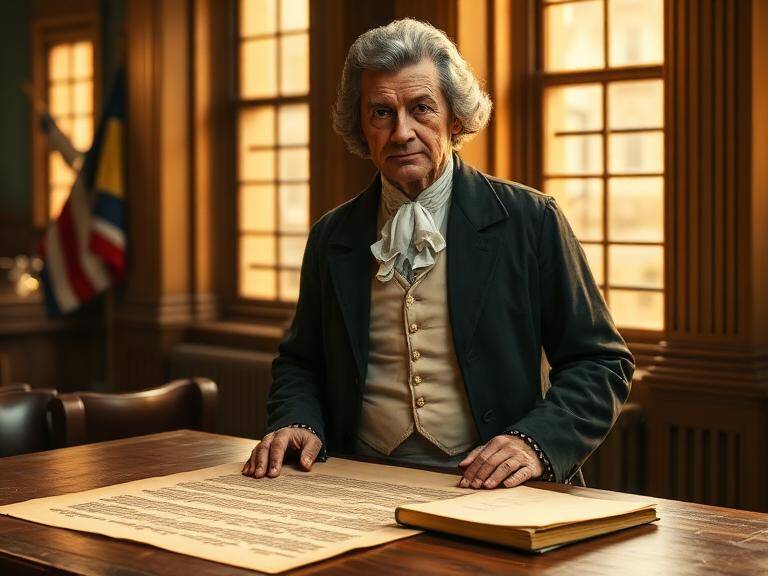
Hero Quote: “I have no idea of submitting to the unjust and oppressive measures of the British Parliament.” - Attributed to the spirit of George Ross's patriotic convictions during the Revolutionary era.
The Life Behind the Signature
Content Summary
Who was George Ross?
- George Ross was born in New Castle, Delaware, in 1730.
- He became a successful lawyer and Crown Prosecutor.
- His political views shifted toward colonial independence.
- He signed the Declaration of Independence for Pennsylvania.
- Ross was connected to Betsy Ross through family by marriage.
- He continued serving the revolutionary cause until poor health forced retirement.
George Ross was a lawyer, Pennsylvania statesman, military officer, and signer of the Declaration of Independence. He represented Pennsylvania in the Continental Congress and played an active role in the American Revolution.
Why did George Ross sign the Declaration of Independence?
Ross believed the colonies deserved self-government and freedom from British control. Therefore, he joined the movement for independence despite significant personal risks.
What happened to George Ross after 1776?
After signing the Declaration, Ross continued serving Pennsylvania and the Continental Congress. Poor health forced him to step back, and he later served on Pennsylvania's Court of Admiralty before his death in 1779.
He died before America won the Revolutionary War.
Introduction: A Revolution Was Brewing
Picture Philadelphia in the summer of 1776. The air felt thick with tension. Soldiers marched through dusty streets. Merchants whispered about war. Meanwhile, delegates gathered to make a choice that could cost them everything.
Then there was George Ross.
Most people hear the name "Ross" and instantly think of Betsy Ross and the American flag. Fair enough. The flag tends to steal the spotlight. Yet behind that famous name stood a lesser-known patriot whose signature helped launch a nation.
George Ross was a Pennsylvania delegate, a respected lawyer, and eventually a signer of the Declaration of Independence. He was also connected to Betsy Ross through family. His nephew, John Ross, married Betsy Griscom in 1773. That family connection has become one of the most intriguing footnotes in American history.
However, George Ross was far more than a relative of a famous seamstress. He faced the same dangers as every signer. By adding his name to the Declaration, he challenged the British Crown and put his wealth, reputation, and life at risk.
Not bad for a man history often leaves in the shadows.
Early Life & Influences
From Delaware Roots to Legal Ambitions
George Ross was born on May 10, 1730, in New Castle, Delaware. His father, an Anglican minister educated at the University of Edinburgh, ensured that his children received a strong classical education at home.
Unlike many future Founding Fathers, Ross did not follow a university path. Instead, he studied law under his older brother. Soon afterward, he earned admission to the Pennsylvania bar at just twenty years old.
A Blend of Faith and Duty
Growing up in a large family shaped Ross's character. His religious upbringing emphasized responsibility, discipline, and service. Consequently, those values guided his future career in law and government.
Although he would begin as a loyal supporter of British authority, education taught him to think critically. As events unfolded, that independent streak became impossible to ignore.
Career & Political Rise
A Loyal Crown Officer Changes Course
At first, George Ross supported the Crown. In fact, he served for roughly twelve years as Pennsylvania's Crown Prosecutor. That position placed him firmly within the British colonial system.
Then something unexpected happened.
As Ross served in Pennsylvania's provincial legislature, he witnessed growing disputes between colonial leaders and Parliament. Gradually, his views shifted. The more he saw, the less he liked London's heavy-handed policies.
Funny how seeing a problem up close can change a person's mind.
A Seat in the Continental Congress
By 1774, Pennsylvania selected Ross as a delegate to the Continental Congress. Soon afterward, he became a strong supporter of colonial rights and independence.
At the same time, Ross wore several hats. He served in Pennsylvania's legislature, worked on the Committee of Safety, and accepted a commission as a colonel. Apparently, the eighteenth century had not yet invented the phrase "work-life balance."
The Call to Action
Why George Ross Signed
By 1776, compromise seemed increasingly impossible. Ross believed the colonies deserved self-government and protection from unjust policies.
Therefore, when the Declaration of Independence came forward, he chose to stand with the cause of liberty. He signed as a representative of Pennsylvania, joining fifty-five other men who pledged their lives, fortunes, and sacred honor.
The Risks Were Real
Today, signing a document often means clicking a button. Back then, it meant potential disaster.
Had Britain crushed the rebellion, George Ross could have lost his property, his standing, and perhaps his life. Every signer understood the stakes. Nevertheless, Ross placed his name on the Declaration anyway.
That decision transformed him from a former Crown official into a revolutionary patriot.
Life After the Declaration
Continuing the Fight
Following the Declaration, Ross continued serving the revolutionary cause. He returned to Congress in 1777 but eventually resigned because of declining health.
Later, Pennsylvania appointed him to its Court of Admiralty. Even as illness worsened, he remained committed to public service.
An Early Farewell
Sadly, George Ross never witnessed the final American victory.
He died on July 14, 1779, at only forty-nine years old. Many historians believe severe gout contributed to his death. As a result, he missed seeing the nation whose birth certificate he had helped sign.
Meanwhile, the legend of Betsy Ross grew larger with each passing generation. Consequently, George Ross often became a supporting character in stories where he deserved a leading role.
Legacy & Reflection
More Than Betsy's Relative
George Ross occupies a fascinating place in American history.
He began as a supporter of the Crown. Then he listened, learned, and changed his mind when principle demanded it. That willingness to grow remains one of his greatest lessons.
Moreover, his story reminds us that history is full of figures who rarely appear in textbooks. While George Washington commands statues and Betsy Ross claims flag lore, George Ross quietly helped secure independence through courage and conviction.
What Can We Learn Today?
His example offers a simple challenge.
Stand for what is right, even when changing course feels uncomfortable. Listen to new evidence. Remain loyal to principles rather than pride.
After all, genuine leadership is not stubbornness. Sometimes it is the courage to rethink old beliefs and act on new truths.
Conclusion
George Ross may never enjoy the fame of other Founding Fathers. Yet his contribution remains essential. As a George Ross Declaration of Independence signer, he helped shape the birth of the United States during one of history's most dangerous political moments.
His journey from Crown prosecutor to revolutionary patriot shows how conviction can overcome comfort. Furthermore, his connection to Betsy Ross adds a fascinating human thread to the broader story of American independence.
While his signature may not be the most famous on the Declaration, it helped change the world just the same.
Call to Action
Did George Ross's story surprise you? Share this article with a fellow history lover and help shine a light on one of America's overlooked Founding Fathers. Every signature on the Declaration mattered, and every story deserves to be remembered.
This post is part of a series on Freedom Inked: The Day America Took to Pen - A series of posts about each of the signers of the Declaration of Independence. See https://activerain.com/droplet/JDT7


Comments(7)