
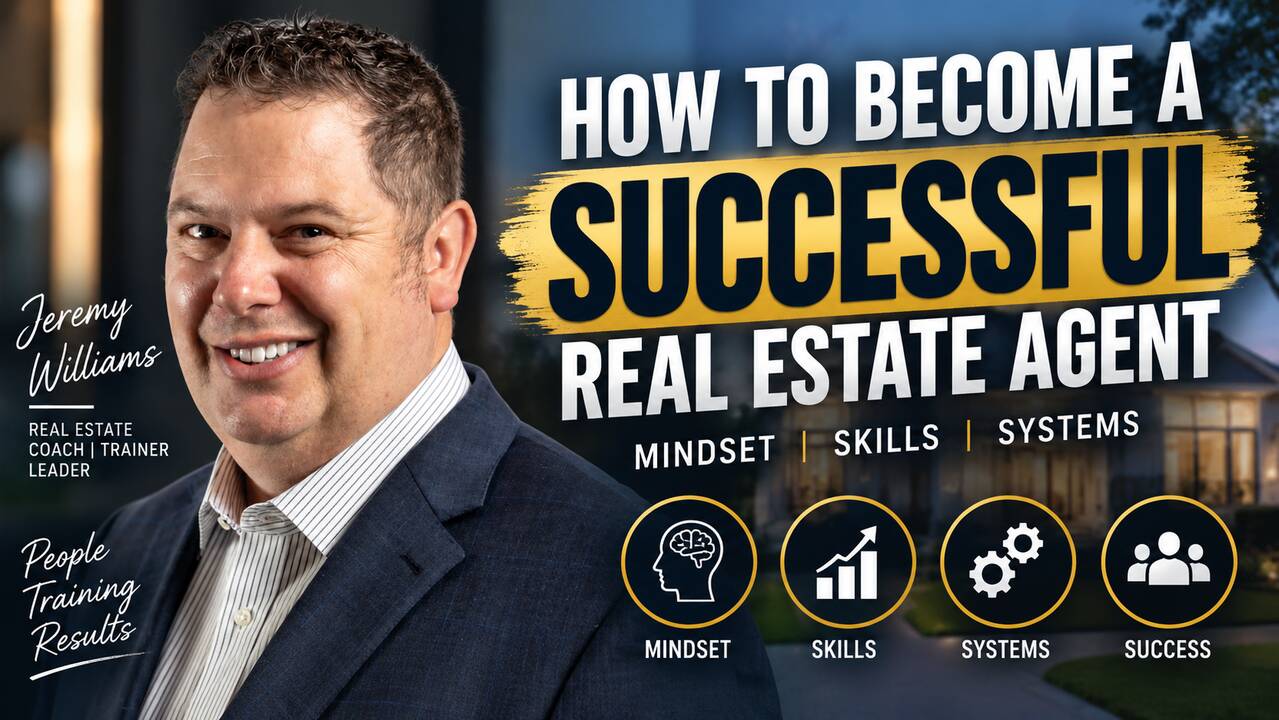
Passing the exam makes you eligible to practice real estate. It does not hand you a business. Anyone who has been licensed more than a year or two already knows the difference, usually because they learned it the expensive way.
I spent a recent training session on what I think is the real dividing line, and it is not talent or territory or how long you have held a license. It is identity. You either see yourself as someone who shows houses and fills out paperwork, or you see yourself as a trusted advisor, a market expert, a business owner, and an advocate for the people who hired you.
Whether you are two months in or twenty years in, the question underneath everything else is the same one: who are you becoming as a real estate professional?
What actually separates the professionals
There is no personality requirement in this business. You do not have to be the loudest voice in the room, you do not need the biggest following, and you do not have to know everyone in town. But a handful of traits show up over and over in the agents who last.
Integrity. Do the right thing when nobody is watching. Every decision feeds the reputation you are building with clients, cooperating agents, lenders, title, and vendors. It takes years to build and one bad call to dent.
Consistency. We are all tempted by the next lead source, platform, or campaign. But results almost never come from one heroic burst of activity. They come from repetition, done on days when you do not feel like it.
Communication. Clients want to know what is happening. Sometimes that is good news. Sometimes it is the call you are dreading. Keeping people informed, setting expectations, and addressing concerns instead of avoiding them is most of the job.
Professionalism. It is not a title, it is a set of behaviors. Be prepared. Be on time. Follow up. Know your market. Know your contracts. Every interaction gives someone a reason to trust you or a reason not to.
Resilience. Deals fall apart. Good agents do not. Inspections, financing, appraisals, title issues, moving timelines, clients under real stress. The professional stays calm and starts hunting for solutions.
Empathy and a learning mindset. These are among the largest financial and emotional decisions people make. Understanding what is actually driving your client lets you serve them better, and staying curious lets you keep up as the industry shifts underneath all of us.
Nobody is going to tell you to prospect
The hardest adjustment for agents coming out of traditional employment is not the money. It is the silence.
In a corporate job, somebody decides when you arrive, what you are responsible for, when the meetings happen, and when you get paid. Real estate deletes all of that.
Nobody tells you to prospect this morning.
Nobody makes you follow up with the thirty-seven people sitting in your CRM.
Nobody schedules your appointments, writes your content, or builds your relationships.
And your income six months from now depends entirely on whether those things happened. In this business you are the structure. You set the schedule, generate the revenue, and run marketing, sales, service, education, and follow-up. That is enormously freeing and enormously heavy, usually in the same week.
The skills worth prioritizing
You can learn hundreds of things in real estate. Not all of them deserve equal weight while you are still building. I would put these seven ahead of everything else.
1. Lead generation and relationships. Talking to people is the business, trust keeps it, follow-up grows it. Great marketing and beautiful technology cannot rescue a pipeline with no conversations in it.
2. Time blocking. Your calendar should reflect your priorities. If lead generation matters, where is it? If your family matters, is that time protected too? Time blocking turns intentions into commitments so you are not deciding each morning what you feel like doing.
3. Market knowledge. Clients do not need us to open doors. Consumers already have the data. Our value is helping them understand what the data means for their decision.
4. Communication. Practice scripts until they stop sounding like scripts. Write better emails. Listen more. Ask sharper questions. This one quietly drives conversion, satisfaction, and referrals.
5. Negotiation. Not winning an argument. Understanding motivation, finding the openings, communicating clearly, and protecting your client's position.
6. Contract competence. Confidence comes from competence. Know the documents you are asking people to sign, know the timelines, and know exactly when to pick up the phone and ask your broker.
7. Technology. Not for its own sake. Your MLS, transaction management, digital signatures, showing systems, and CRM should be saving you time and preventing mistakes. If a tool is not doing that, it is a hobby.
At some point motivation runs out and systems take over
Without systems, this job becomes pure reaction. A text. An email. An inspection issue. A showing request. Somebody needs a document. A prospect finally calls back. The day evaporates, you were genuinely busy, and not one thing you did will generate business ninety days from now.
The systems that matter are not complicated:
Daily time blocks for prospecting, appointments, admin, and personal priorities, then actually defended.
A lead generation routine your sphere and past clients get year-round, not only when things slow down.
CRM follow-up that runs whether or not you remember. The fortune is in the follow-up, but only the follow-up that happens.
Consultation checklists for buyers and sellers, so the important topics never get skipped on a busy week.
Transaction checklists from contract to close, managing deadlines on purpose instead of from memory.
A weekly review. What happened, what is coming, what needs attention, where am I short. Then adjust.
Systems matter. Tools matter. But people matter too, and this is the part solo-minded agents miss. The strongest businesses in this industry run on relationships with lenders, title reps, inspectors, contractors, stagers, coordinators, accountability partners, and cooperating agents. You do not have to be excellent at everything. You have to be excellent at knowing who to call.
The REALTOR® distinction
There is a real difference between holding a license and being a REALTOR®. The designation reflects membership in the National Association of REALTORS® and a commitment to its Code of Ethics and professional standards.
I would push the thinking further than membership, though. You are developing into a fiduciary, a strategic advisor, a marketing specialist, a problem solver, a negotiator, and an advocate in your community. That is a very different identity than someone whose main value proposition is unlocking a door. Our clients deserve more than that, and honestly, so does our industry.
Identity shapes habits, habits shape outcomes
It all loops back to identity. Who do you believe you are? Because that belief shapes your habits, and your habits produce your outcomes. The small things you repeat this month become the results you are living with two years from now.
Which is why building a career in this business is not really about finding one more script or one more lead source. It is about becoming the person capable of running the business you keep saying you want.
Operate with integrity. Be consistent. Know your market. Talk to people. Follow up.
Honor your calendar. Learn your contracts. Use your systems. Ask for help. Keep learning. Then do it again tomorrow.
You are not just closing transactions. You are building a business, a brand, a reputation, and a future.
Jeremy Williams is Founder and Expansion Partner of Omnia Elevate, an agent development organization within JLA Realty, serving Greater Houston, Greater San Antonio, and the Texas Coastal Bend.
Omnia Elevate is an agent development organization within JLA Realty (Universal Home Solutions, LLC), a licensed Texas real estate brokerage. Omnia Elevate is not a real estate brokerage and does not hold a real estate license. This article is general education for real estate professionals and is not a representation, projection, or guarantee of income, production, or results; individual outcomes vary. All real estate commissions and fees are negotiable and are not set by law or by any association of REALTORS®.
Continuing education credit in Texas is available only through providers and courses approved by the Texas Real Estate Commission. Nothing in this article is a TREC-approved continuing education course or carries CE credit.
JLA Realty and Omnia Elevate are independent of, and are not affiliated with, endorsed by, or sponsored by, the Houston Association of REALTORS®, the San Antonio Board of REALTORS®, Texas REALTORS®, or the National Association of REALTORS®. REALTOR® is a registered collective membership mark identifying a real estate professional who is a member of the National Association of REALTORS® and subscribes to its Code of Ethics. This article is not directed at, and is not intended to induce a breach of, any exclusive representation, employment, or independent contractor agreement between a license holder and another broker.
Equal Housing Opportunity. We do business in accordance with the federal Fair Housing Act and the Texas Fair Housing Act.
TREC Information About Brokerage Services · TREC Consumer Protection Notice · Texas Real Estate Commission, P.O. Box 12188, Austin, TX 78711-2188, (512) 936-3000.

Comments(1)