
There is a phrase we use all the time in this industry that may actually be creating part of the confusion: modular home.
It sounds as if a modular home is a completely different kind of housing, sitting in its own category somewhere between a conventional house and a manufactured home. That is how many consumers hear it. It is also how some Realtors, lenders, zoning officials, and even builders still think about it.
But that is not really what modular means.
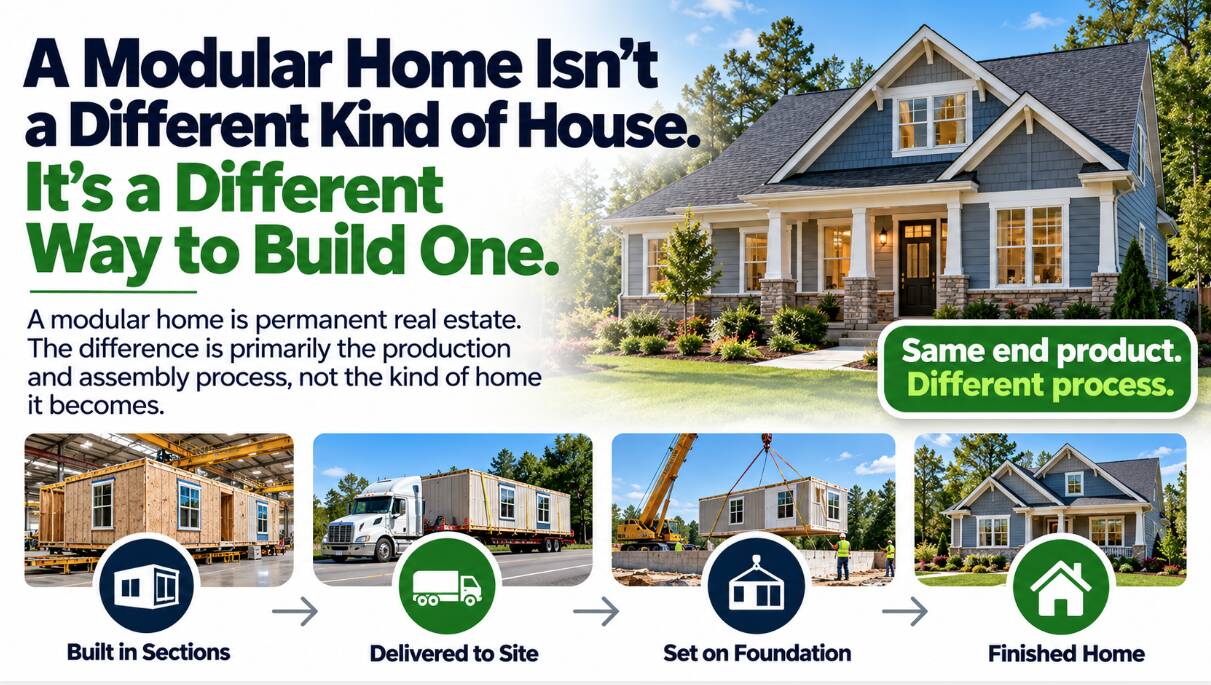
Modular is primarily a construction method. The finished product is a permanent house. The difference is where much of the construction happens and how the pieces arrive at the building site.
That distinction sounds small. For a Realtor working with a buyer who is considering building, it is enormous.
Start With the Finished House, Not the Factory
Imagine two houses sitting next door to each other. They have similar architecture, similar square footage, similar kitchens, similar garages, and both sit on permanent foundations.
One was framed almost entirely outdoors on the lot. The other was built largely inside a factory in large three-dimensional sections, transported to the property, lifted onto the foundation, connected, and completed onsite.
From the buyer's point of view, both are houses. From the building-code point of view, both are governed by the residential construction requirements that apply where the home will be located. The major difference is the production process.
That is why I think Realtors should stop thinking of modular as a housing style and start thinking about it as another way to deliver a new home.
What Actually Changes With Modular Construction?
The biggest change is not what the customer owns at the end. It is what happens before the home reaches the foundation.
With conventional site construction, lumber, sheathing, windows, plumbing components, electrical materials, drywall, cabinets, fixtures, and dozens of other materials are delivered to a jobsite. Crews then assemble the house there over a period of months.
With modular construction, a substantial portion of that work is moved into a manufacturing environment. The home is divided into modules. Those modules are framed, wired, plumbed, insulated, drywalled, and finished to varying degrees in the factory before being transported to the property.
Meanwhile, work can be moving forward at the site. Excavation, utilities, foundation work, and other site activities can occur while the house is being produced. That overlap is one of the fundamental reasons modular construction can compress the overall construction schedule.
Modular Home Source explains the comparison between modular and site-built construction in more detail.
The Building Code Is One of the Most Important Things a Realtor Should Understand
This is where the confusion between modular and manufactured housing becomes more than semantics.
A modular home is built to the applicable state and local residential building codes for the jurisdiction where it will be installed. A manufactured home is constructed under the federal HUD manufactured-housing code and is built on a permanent chassis.
Those are different regulatory systems. They should not be treated as interchangeable terms.
For a Realtor, that distinction can affect the questions surrounding zoning, financing, appraisal, insurance, resale, and the way the property is described to a buyer.
Impresa Modular's core explanation of modular construction emphasizes that the home is built using the applicable residential building code, even though much of the work happens offsite.
A Permanent Foundation Changes the Conversation
A modular home is transported to the site in sections, but the transportation system is not the identity of the finished house.
The modules are removed from their carriers and installed on a permanent foundation. The structure is connected, utilities are completed, exterior and interior finish work is performed, inspections are completed, and the home becomes part of the real property.
That is very different from the mental picture many consumers still have when they hear factory built.
The fact that a house traveled down the highway does not mean it remains a movable house after completion.
Impresa Modular also explains what a modular home is and why the finished property functions like conventional permanent housing.
What About Financing and Appraisal?
This is another area where terminology matters.
Because modular homes are permanent code-built houses, they generally move through mortgage, appraisal, insurance, and resale channels in the same manner as other permanent residential construction. During the build, buyers commonly use construction financing, and after completion the property functions as conventional real estate.
The important lesson for the Realtor is not to assume that factory construction automatically means a different class of real estate.
Ask what building code governs the home. Ask whether it will be installed on a permanent foundation. Ask how the project will be titled and financed. Those questions tell you far more than the word prefab ever will.
Can You Tell a Modular Home by Looking at It?
Usually, no.
A modular home can be a ranch, Cape Cod, farmhouse, two-story traditional, contemporary design, or something highly customized. The modules have to be designed around transportation and assembly constraints, but the finished architecture does not have to advertise the construction method.
That is another misconception Realtors can help eliminate.
Modular is not an architectural style. It is not a roof pitch. It is not a double-wide appearance. It is a production system.
I have written before about why site-built and modular homes should be compared as two ways of producing the same type of finished house.
The Realtor Opportunity Is Understanding the Process
You do not need to know how to engineer a marriage wall, calculate crane reach, or design a module to help a client considering modular construction.
You do need to understand enough to keep the client from making decisions based on bad assumptions.
If a buyer says, 'I don't want a modular home because they don't appreciate,' that is an education opportunity.
If a seller says, 'I was told I have to disclose this as a manufactured home,' that deserves a closer look.
If a buyer finds a home plan they love but assumes it cannot be built modular because it does not look modular, that is another education opportunity.
The Realtor who understands the difference can keep the conversation grounded in the actual property instead of decades-old stereotypes.
One of the most persistent myths is that modular construction is simply another name for manufactured housing, a misconception I addressed in Fact or Fake: The Truth About Today's Modular Construction.
The Bigger Question
Housing has spent a long time defining homes by the place where the labor happened.
I am not sure that makes much sense anymore.
We do not describe a car as factory built every time it changes owners. We evaluate the vehicle itself.
Perhaps housing eventually gets there too.
The question should not be, 'Is this a modular house?'
The better questions are: Was it built to the right code? Is it well designed? Is it well constructed? Is it installed correctly? Does it perform well? Is it appropriate for the site? And does it solve the buyer's housing problem?
Those are questions Realtors already know how to help clients think through.
Modular simply gives them another way to get to the finished home.
For the Realtors here on ActiveRain: when a buyer tells you they would consider a modular home, what is the first question you ask them? And do you find that your clients understand the difference between a modular home and a manufactured home before you explain it?



Comments(10)