
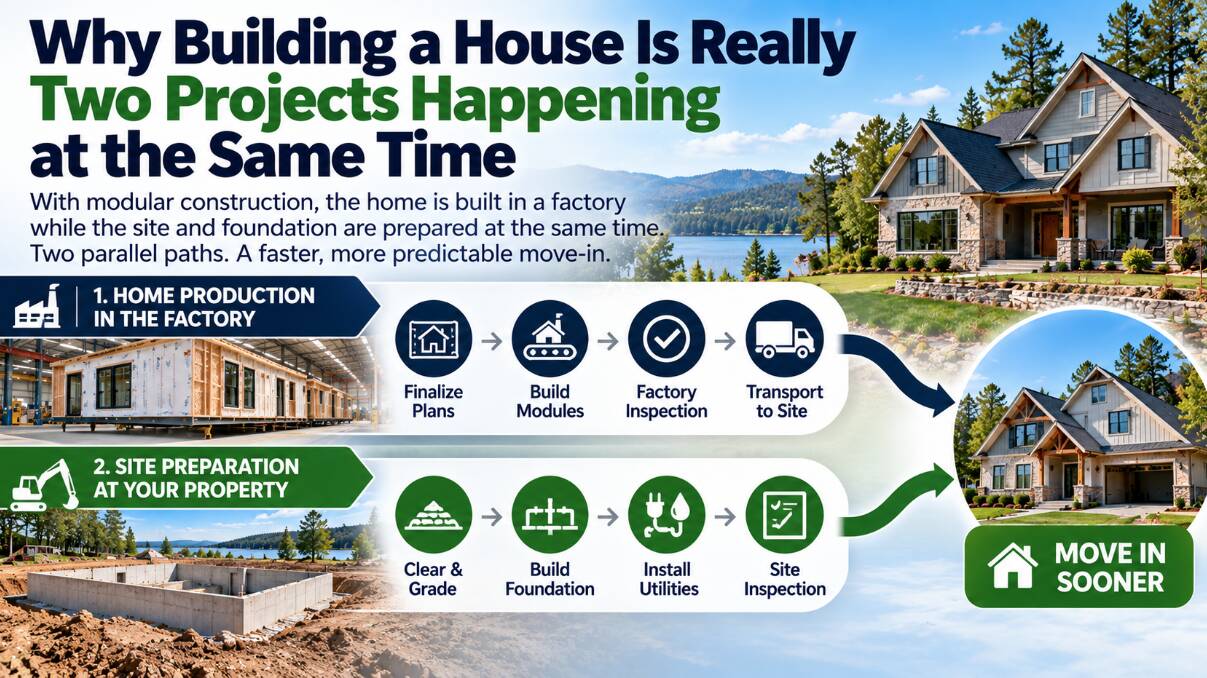
When most people picture a house being built, they picture one project happening in one place. The lot is cleared. The foundation goes in. Framing starts. Then roofing, windows, wiring, plumbing, insulation, drywall, cabinets and finishes follow in a long sequence.
That mental picture makes sense because it is how most of us have seen houses built for generations.
But modular construction changes the sequence in a very important way.
Instead of waiting for the site to be ready before the house itself can really begin, the project can move forward on two tracks at the same time.
One project is happening in the factory.
The other project is happening on the land.
And understanding how those two tracks come together is one of the easiest ways for a Realtor to understand why modular construction can change a building schedule.
Project One: The House Is Being Built in the Factory
The first project is the home itself.
Once plans, engineering, selections and approvals are sufficiently complete, the modules can move into production. Floors, walls and roof systems are assembled indoors. Electrical, plumbing, insulation, drywall, cabinetry and many interior finishes can be installed before the home ever reaches the property.
A good visual explanation of how modular homes are built in the factory shows how much of the structure and interior can be completed before delivery, while foundation work is progressing at the property.
That matters because the house is not sitting on the property waiting for each trade to arrive before the next step can begin. Work is organized around a production process, with specialized crews and inspections occurring as the home moves through the factory.
For a Realtor, the important point is not memorizing every station in the factory. It is recognizing that the physical home can be advancing even though the buyer may drive past the lot and see very little vertical construction yet.
That can feel strange to a client who is accustomed to measuring progress by what they can see from the road.
Project Two: The Property Is Becoming a Building Site
At the same time, an entirely different project is happening outside the factory.
The building site has to be made ready for the house.
That can include clearing, grading, excavation, driveway access, temporary utilities, foundation construction, well and septic work where applicable, utility coordination, drainage, permits and the logistics required for delivery and crane access.
That is why preparing a lot for a modular home deserves its own planning track. The house and the land have separate tasks, costs, risks and deadlines.
This is why I keep telling people that the site is not a minor detail attached to the home purchase. It is half of the project.
A perfectly built house cannot overcome a foundation that is late, an access route a delivery truck cannot navigate, utilities that were never coordinated or a site budget that was underestimated.
The factory side and the site side are different workstreams, but they are completely dependent on each other.
The Advantage Is Not Simply That the Factory Is Faster
People often describe modular construction as faster construction. That is partly true, but I think the more important word is parallel.
Traditional site construction is highly sequential. Many steps cannot begin until the previous step is completed. A foundation has to be ready before framing can start. The structure has to be dried in before many interior trades can proceed. Weather can interrupt multiple stages of that sequence.
Impresa Modular's Understand the Process overview makes the same point from the owner’s perspective: planning, financing, site work, factory construction and onsite completion have to be coordinated as parts of one schedule.
Modular construction changes that relationship. The home can be moving through factory production while the foundation and site work are moving forward miles away.
You are not eliminating the work. You are reorganizing it.
That distinction matters because genuine productivity gains in construction rarely come from simply asking people to work faster. They come from changing sequencing, reducing idle time, controlling variability and allowing compatible activities to happen concurrently.
The Two Timelines Have to Meet
Parallel construction only works when the two tracks are coordinated.
Imagine the factory finishes the home but the foundation is not ready. The modules cannot simply sit indefinitely while the site catches up. Now imagine the opposite: the foundation is complete, but approvals or production delays keep the home from arriving. Capital and time are tied up while the site waits.
The objective is synchronization.
The site needs to be ready when the modules are ready. The foundation must be properly built and cured. Delivery access must be confirmed. The crane location has to work. Utilities and inspections have to be sequenced around the set and finish schedule.
The responsibilities outlined in What You Do also show why the owner-side schedule cannot be treated as an afterthought. Permits, subcontractors, inspections and materials all have to line up with production.
That is why modular construction is not simply 'a house built in a factory.' It is a coordinated delivery system connecting design, manufacturing, logistics and site construction.
When those interfaces are managed well, the schedule can compress dramatically. When they are managed poorly, modular does not magically rescue the project.
What This Means for the Realtor
This is where Realtors can add more value than many realize.
You do not need to manage the construction schedule. You do not need to know how to pour a foundation or coordinate a crane. But if your buyer is considering building, understanding that there are two simultaneous projects helps you ask better questions.
Has the site been evaluated? Is the lot suitable for the proposed home? Has access been considered? Are utilities available? Is the foundation scope understood? Is the customer budgeting for the complete project rather than just the factory price? Who is responsible for coordinating site work?
The Factory to Foundation: The Journey of Your Custom Modular Home article describes the same principle plainly: site preparation and factory production can proceed concurrently, which is where much of the schedule advantage originates.
Those questions keep the Realtor relevant because land and local knowledge remain central to the project even when much of the house is being produced somewhere else.
A Realtor who understands the basic sequence can also help manage buyer expectations. When the customer visits the property and sees a foundation but no house, that does not necessarily mean the project is stalled. The house may already be substantially complete inside a factory.
Then Comes the Moment the Two Projects Become One
The most visible moment in modular construction is set day.
The modules arrive. A crane lifts them onto the completed foundation. Sections are joined. In a matter of hours, a property that may have looked like a foundation in the morning can look like a substantial house by the end of the day.
But set day is not magic. It is the intersection of everything that happened before it.
That parallel logic is also central to The Modular Difference: How We Deliver Your Dream Home Faster, where factory production and site preparation are described as simultaneous workstreams that converge at delivery and set.
Factory production had to finish. Transportation had to be coordinated. The site had to be accessible. The foundation had to be right. The crane had to have a workable location. Permits, inspections and crews had to line up.
What looks like a dramatic one-day transformation is really the payoff from two coordinated schedules that have been moving toward the same date.
This Is the Bigger Lesson About Offsite Construction
The real advantage of offsite construction is not that we discovered how to build walls indoors.
It is that we can reorganize the construction process.
We can separate work that does not need to happen in the same place, control more of that work in a manufacturing environment and then coordinate the interfaces where the pieces come back together.
That is an important distinction for Realtors because your client does not experience the factory and the site as separate businesses. They experience one project, one budget and one future home.
The better the industry becomes at coordinating those two projects, the more predictable the overall delivery process becomes.
So the next time a buyer tells you they are considering modular construction, picture two jobsites instead of one.
One is the property you can drive past.
The other may be hundreds of miles away inside a factory.
Both are building the same house.
For those of you who work with new construction: how often do your buyers understand that site work and home production can be moving forward at the same time?



Comments(10)