
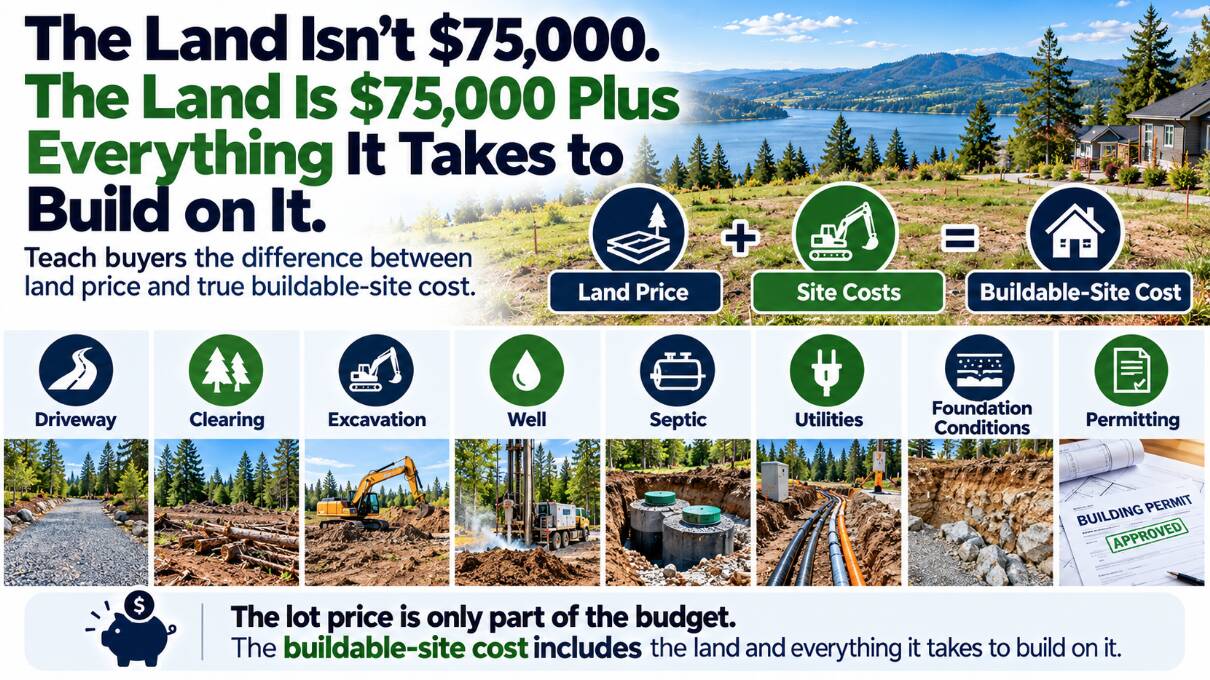
The purchase price is only the first number. Realtors who understand buildable-site cost can help buyers avoid expensive surprises before they fall in love with the wrong lot.
THE LAND PRICE IS NOT THE BUILDING-SITE PRICE.
I have watched buyers spend weeks negotiating the price of a piece of land and almost no time asking what it will cost to make that land ready for a house. That is backwards.
A $75,000 lot is not a $75,000 building site. It is a $75,000 piece of dirt plus whatever it takes to create access, clear it, excavate it, deal with the soil, install a foundation, bring in utilities, solve water and wastewater, obtain permits, manage drainage and make the property physically ready to accept a home.
Sometimes those additional costs are reasonable. Sometimes they completely change the economics of the project. And the buyer usually discovers the difference after they have emotionally committed to the property.
That is where a Realtor who understands new construction can add enormous value.
The Realtor does not have to estimate excavation, design a septic system or engineer a foundation. But the Realtor should know enough to recognize that the asking price of the lot and the cost of the buildable site are two very different numbers.
The Lot Price Is Only the Opening Number
Start with access. I am not just talking about whether there is a road in front of the property. Can construction equipment get onto the site? Can concrete trucks get where they need to go? Can a modular home delivery truck and crane reach the foundation location? Is there a narrow bridge, a sharp turn, a steep grade, overhead wires or tree cover that changes the logistics? A beautiful secluded lot can become expensive very quickly if getting equipment to the building area becomes a project by itself.
Then look at clearing and excavation. A wooded lot may photograph beautifully. It may also require tree removal, stump removal, grading, erosion control and hauling. A sloped lot may create a great view, but that view can come with retaining walls, deeper excavation, additional fill, drainage work and a more complicated foundation. Rock is even less impressed by the buyer's budget. If you find it where the foundation needs to go, the excavation number can change fast.
Water and wastewater are another major dividing line. Public water and sewer can simplify a project, but even then there may be tap fees, impact fees and long connection runs. No public sewer? Now the buyer needs to understand septic feasibility. No public water? Add the well. These are not details to solve after closing on the land. They are part of determining whether the land fits the project at all.
Utilities are similar. Buyers often see a power line somewhere near the property and assume electricity is handled. It may not be. Distance to the building site matters. Transformer requirements matter. Trenching matters. Gas availability matters. Internet can even matter, especially for someone moving to acreage because they expect to work from home. The lot may have utilities nearby without having utilities economically available where the house will actually sit.
Then there is the foundation. People tend to think of a foundation as a fixed line item. It is not. Soil conditions, slope, drainage, groundwater, frost requirements and the design of the home all matter. A crawlspace, basement and slab are very different scopes. A lot that requires substantial engineered work can turn an inexpensive land purchase into an expensive building site.
Permitting is the category almost nobody gets excited about, but it can move the budget too. Building permits, septic permits, driveway permits, well permits, stormwater requirements, impact fees, utility connection fees and local engineering requirements vary tremendously from one jurisdiction to another. A buyer who asks only, 'What is the property tax?' is asking one of the cheaper questions.
The Buyer Lives in the Completed Project
This is why I keep pushing the idea of total project budget. The buyer does not live in the factory price of the house. They do not live in the land price either. They live in the completed project.
Think of it this way: Land + Site Development + Foundation + Utilities + Home + Onsite Completion + Soft Costs = The Real Project.
That equation is far more useful than asking whether a lot is cheap.
At Modular Home Source, we explain this directly when discussing buying land for a modular home and budgeting beyond the base price. The point is not that site work is somehow unique to modular construction. It is not. Site-built homes need roads, utilities, foundations, permits and drainage too. The difference is that modular buyers are often looking at a separate factory home price, which makes it easier to forget everything outside the house itself.
Impresa Modular approaches the project the same way. Understanding what a modular home is helps separate the house from the site work, while understanding the construction process makes it clear that the site still has to be prepared correctly before the home arrives. Modular can improve the production process. It does not make bad dirt magically become good dirt.
What the Realtor Really Needs to Know
I wrote previously about key factors to consider when choosing land because this problem repeats itself constantly. Access to utilities, site conditions, restrictions and development requirements are not secondary considerations. They are part of the purchase decision. The same lesson shows up when you look at the factory-to-foundation journey: while the house can be produced efficiently offsite, the property still has to be made ready for it onsite.
For Realtors, this creates a different way to think about land. Your job is not to tell the buyer what the driveway will cost. Your job is to know that the driveway has a cost. You do not need to approve the septic design. You need to know that a failed perc test can change the project. You do not need to engineer the foundation. You need to recognize that slope, soil and drainage can change the foundation budget.
That is the difference between selling dirt and helping someone buy a building site.
And there is another important point. A buyer can overpay for cheap land just as easily as they can overpay for expensive land. A $50,000 lot that needs $120,000 of difficult site work may be a worse deal than a $90,000 lot that is nearly ready to build. Purchase price alone tells you almost nothing about the economics of the finished project.
This is where I think Realtors who understand new construction have a real advantage. They begin asking better questions earlier. They help the buyer slow down before the view, the acreage or the price creates emotional momentum. They know when to bring in the builder, excavator, septic professional, surveyor or engineer before the buyer owns a problem.
Cheap Land Can Be Expensive Land
The goal is not to scare buyers away from land. Quite the opposite. It is to help them buy the right land with their eyes open.
So the next time a buyer says, 'Ken, I found five acres for only $75,000,' my first reaction would not be, 'That sounds like a great deal.'
My first question would be: 'Great. What will it cost to make it ready for the house?'
That is the number that matters.
Realtors, when you are helping someone buy land to build, how far into site-development questions do you normally go before you recommend bringing the builder or other professionals into the conversation?

Comments(5)