
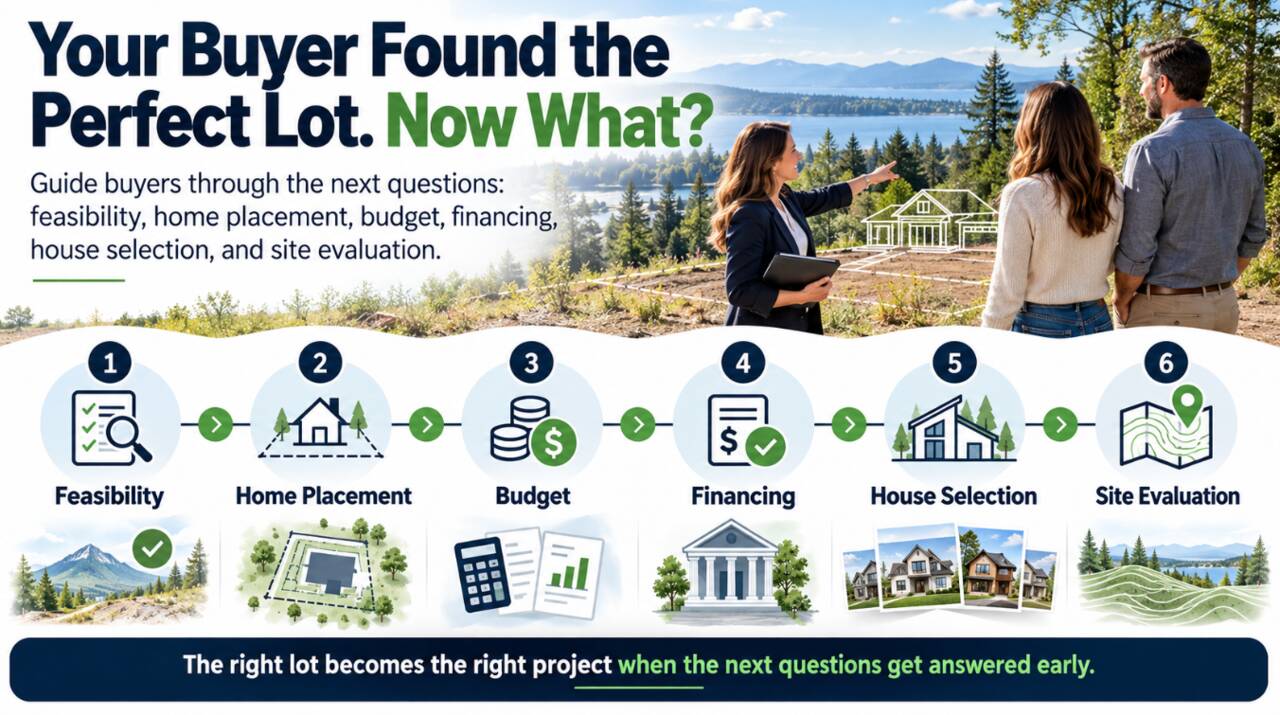
There is a moment in almost every land search when the buyer stops seeing dirt, trees, slope, utilities and setbacks and starts seeing the house. They pull into the property, walk toward the view, point at a spot and say, ‘This is it.’
That is exactly when the Realtor needs to slow the conversation down just enough to protect the buyer from getting ahead of the project.
Finding a lot you love is not the same thing as proving that the lot can support the home you want, at the budget you have, with the financing you can obtain. Those pieces have to come together in the right order.
I have watched buyers do it backwards for years. They fall in love with the land, then fall in love with a house plan, then call the lender, then finally ask someone to evaluate the site. By that point, they may have built an entire project in their head that the property, the budget, or both simply cannot support.
First Question: Is the Lot Really Buildable for This Buyer?
Before anyone spends hours choosing kitchens and rooflines, somebody needs to determine whether the property works. That does not mean the Realtor becomes an engineer, excavator or septic designer. It means the Realtor knows enough to recognize that buildability is a separate question from whether the parcel is attractive.
Access matters. Utilities matter. Soil matters. Zoning matters. Setbacks matter. Drainage matters. The foundation condition matters. On a modular project, delivery and crane access matter too. A parcel can be legal to sell and still be a poor fit for the buyer’s intended home.
A good place to start is a real site review. Modular Home Source has a practical guide on buying land for a modular home that focuses on access, utilities, zoning and soil before the buyer commits. That is the mindset I want Realtors to have. You are not expected to answer every technical question. You are expected to know which questions cannot be ignored.
Where Does the House Actually Go?
Once the lot appears feasible, the next question is not simply, ‘What house do you like?’ It is, ‘What house fits this site?’
That distinction matters more than most buyers realize. A long narrow lot creates different choices than a wide lot. A sloped site may favor a walkout foundation. Setbacks can dictate the usable building envelope. Driveway location may affect how the home sits. Septic fields, wells, easements, wetlands and utility corridors can consume pieces of the property the buyer thought were available for the house.
This is why I like the way Modular Home Source approaches choosing the right modular floor plan. The home has to fit the buyer’s life, but it also has to fit the land. Those two decisions should happen together, not in separate rooms with different people.
Now Build the Whole Budget, Not Just the House Budget
This is where many projects either become real or begin to unravel.
The buyer may say, ‘We can spend $600,000.’ Fine. But is that $600,000 for the house? Or is it $600,000 for the land, house, foundation, excavation, driveway, well, septic, utility connections, permits, crane, site work, finishes, loan costs and contingencies?
Those are completely different conversations.
At Impresa Modular, the planning process begins with budgeting, financing, land and plans because those decisions are connected. The What You Do page lays out that sequence plainly. The buyer selects the land and building site, develops the financing plan and works through the home design with the realities of the project in view.
I would rather have a buyer discover early that the project needs to change than discover it after they have signed contracts, paid deposits and emotionally committed to a plan that no longer fits the total budget.
Financing Needs to Enter the Conversation Earlier Than Most Buyers Think
With an existing home, the buyer can often start with a preapproval and shop within that range. Construction is different because the lender is underwriting a project that does not yet exist as a completed house.
The lender may need the land information, plans, specifications, builder contract, site costs and appraisal assumptions before the construction loan can be finalized. That is why financing cannot be something the buyer gets around to after picking everything else.
Impresa Modular’s Get Pre-Qualified resource makes the point directly: determine the buyer’s financing range before choosing a home design that may not fit it. And the company’s article on the
seven steps of modular home construction financing
explains how plans, land documentation, contracts, appraisal and draw schedules all become part of the loan process.
That is useful knowledge for a Realtor because it changes the question from, ‘Can my buyer afford this house?’ to, ‘Can my buyer finance this entire project?’
Only Then Should the Buyer Fall in Love With the House
I know that sounds backwards. The house is the fun part. Buyers want to look at floor plans first. I understand it. I have spent my career helping people build homes.
But the right house on the wrong lot is the wrong house.
A beautiful 2,600-square-foot plan can create an ugly budget if the footprint fights the topography, requires extensive excavation or forces expensive foundation work. A slightly different plan may fit the same property beautifully and save tens of thousands of dollars in site work.
That is where good planning beats good marketing. The buyer should be selecting a home that works with the lot and the budget, not forcing the lot and budget to accommodate a home selected in isolation.
The Site Evaluation Is Where the Assumptions Get Tested
At some point, somebody has to stop talking in generalities and look at the actual property.
Where can the house sit? Where can equipment enter? How much clearing is required? Where are the utilities? What foundation makes sense? Is there room for septic? Where will the driveway go? Can delivery trucks and a crane reach the building location? What conditions could materially change the cost?
That is why I consider a professional site evaluation one of the most important early steps in a building project. Impresa Modular has written specifically about why site assessments should happen before buyers get too far into the project. A site assessment is where assumptions about the land begin turning into usable information about feasibility and cost.
For a Realtor, that evaluation is not a threat to the transaction. It is protection for the client and, frankly, protection for the relationship.
The Realtor Does Not Have to Know Everything
I keep coming back to this because I think some Realtors hear ‘new construction’ and assume they are expected to know how to build a house.
You are not.
But you should understand the sequence well enough to keep the buyer from skipping the important questions.
A good Realtor can help the buyer identify land, understand local market value, recognize zoning and location issues, coordinate with the builder and lender, help sell the buyer’s existing home, and stay involved as the project moves from property search to completed real estate.
That is a valuable role. In many cases it is more valuable than simply unlocking doors on houses that already exist.
The Perfect Lot Is Only Perfect After the Questions Are Answered
So your buyer found a piece of land they love. Great.
Now ask what comes next.
Can we build on it? Where does the house go? What does the entire project cost? How will it be financed? Which home fits both the family and the property? What does the site evaluation tell us that we could not see from the road?
Answer those questions in the right order and that beautiful piece of land can become the beginning of a very good project.
Skip them, and the ‘perfect lot’ can become the most expensive mistake in the entire build.
For the Realtors here on ActiveRain who work with land or new construction: when your buyer finds a lot they love, what is the first question you ask before they move forward?



Comments(7)