
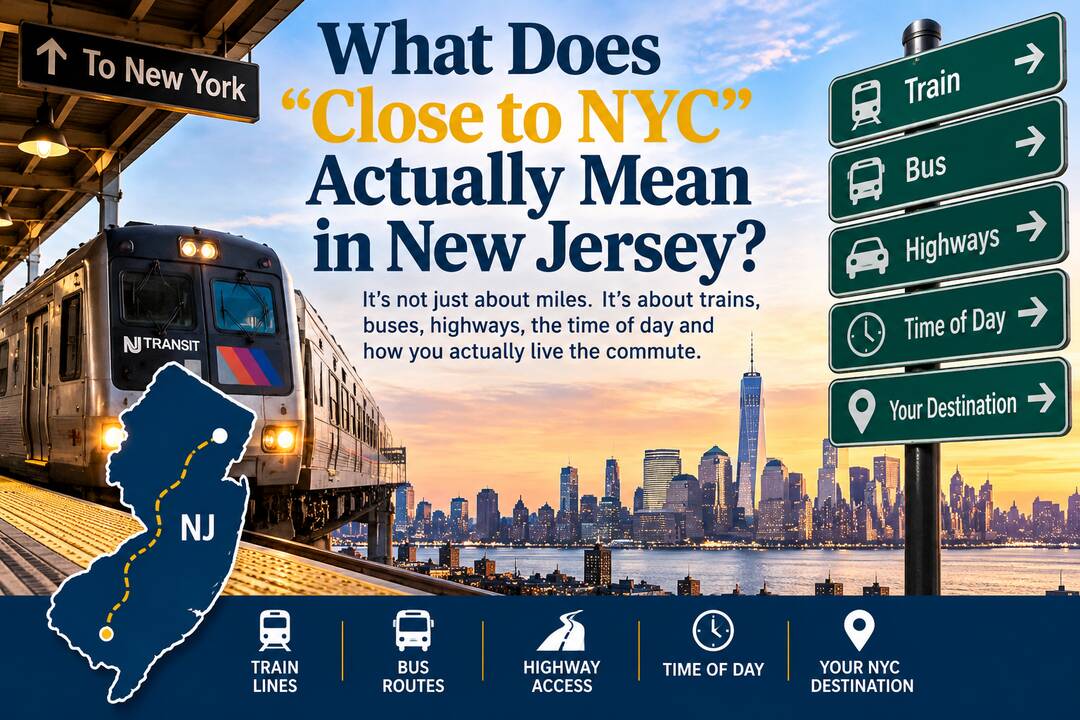
Close to NYC? What NJ Homebuyers Should Know Before Buying
Buying a home in New Jersey near NYC is about more than distance. It is about finding a location that works for your commute, lifestyle, budget and long-term goals.
Is Your New Jersey Dream Home Really Close to NYC?
Five miles from Manhattan sounds convenient. But what if those five miles take an hour to travel?
That is a question New Jersey homebuyers should ask before falling in love with a property advertised as "close to NYC."
In New Jersey real estate, proximity to New York City is one of the most frequently promoted location benefits. Buyers regularly encounter phrases such as "minutes to Manhattan," "NYC commuter friendly," "convenient transportation," and "easy access to New York."
But what do those descriptions actually mean?
A property located 12 miles from Manhattan may offer a more predictable commute than another property just five miles away. The difference could be access to an express train, direct bus service, a PATH station, highway congestion, or the location of your final destination in New York City.
Buying a home in New Jersey near NYC requires looking beyond a map and understanding how a particular location supports your everyday life.
Whether you are considering Union County, Essex County, Hudson County, Middlesex County, Morris County, or Somerset County, the right location is not necessarily the one closest to Manhattan.
It is the one that fits how you live.
1. Distance to NYC Is Not the Same as Commute Time
One of the biggest misconceptions in New Jersey real estate is that shorter distances automatically translate into easier commutes.
Consider two hypothetical homebuyers.
Buyer A purchases a home five miles from Manhattan but must navigate local traffic, parking limitations, and multiple transportation connections.
Buyer B purchases a home 25 miles from Manhattan near a train station offering direct service to New York Penn Station.
Despite living farther away, Buyer B may enjoy a more predictable travel experience.
The important factors include:
Distance from home to the train station or bus stop
Direct service versus required transfers
Express versus local transportation
Rush-hour traffic patterns
Parking availability and costs
Walking distance from the NYC arrival point to the final destination
Weekend, evening, and holiday service
Consumer takeaway: Ask for the actual door-to-door commute, not simply the mileage to Manhattan.
2. NJ Transit Train Access Can Change the Homebuying Equation
For buyers considering New Jersey communities with rail service, proximity to a train station can influence daily convenience and property preferences.
The NJ Transit rail network connects numerous suburban communities with major transportation hubs, including Newark Penn Station, Hoboken Terminal, and New York Penn Station.
However, not every train station provides the same travel experience.
Direct train service versus transfers
Some routes offer direct service to Manhattan, while others require connections at locations such as Newark Penn Station or Secaucus Junction.
A transfer may add time, but it may also provide access to destinations that are not served directly.
For example, buyers exploring Plainfield, Fanwood, Scotch Plains, Westfield, Cranford, and nearby Union County communities should investigate the Raritan Valley Line, including the availability of direct service and transfers during their intended travel hours.
Other buyers may prioritize the Northeast Corridor, Morris & Essex Lines, North Jersey Coast Line, or other NJ Transit services.
Before purchasing a home near a train station, investigate:
The actual train schedule during your commuting hours.
Whether your trip requires a transfer.
Station parking permits, waiting lists, and daily parking costs.
Walking or driving time from the property to the station.
Return service during evenings and weekends.
Visit NJ Transit for current train schedules, route information, fares, and service advisories.
Does living near a train station increase home value?
Convenient transportation access can be an attractive property feature, particularly for buyers who expect to commute regularly.
However, its effect on property value depends on the local market, property condition, housing supply, pricing, and buyer demand.
A home within walking distance of a station may command different buyer interest than a comparable property requiring a longer drive.
That does not mean every station-adjacent property automatically sells for more.
A comparative market analysis should evaluate actual local sales rather than assume a universal transportation premium.
3. Bus Transportation May Be the Better Lifestyle Choice
Rail service receives considerable attention, but New Jersey's commuter bus network deserves equal consideration.
For some buyers, a nearby bus route may provide a more convenient connection to Manhattan than traveling to a train station.
NJ Transit and other authorized transportation providers operate routes serving various New Jersey communities.
Depending on the location and schedule, a commuter bus may offer access to the Port Authority Bus Terminal or other New York City destinations.
Why bus access matters
A homebuyer working near Times Square or Midtown West may find a bus arrival at Port Authority particularly convenient.
Another buyer whose office is closer to New York Penn Station may prefer rail service.
Neither option is universally better.
The answer depends on the specific commute.
Before selecting a neighborhood, investigate bus stop locations, service frequency, traffic exposure, parking requirements, and return schedules.
Lifestyle question: Would you rather walk five minutes to a bus stop or drive fifteen minutes to a train station?
Your answer may change which New Jersey homes deserve your attention.
4. Highway Access: Convenient on Paper, Different in Practice
New Jersey's highway network offers access to New York City and major employment centers throughout the region.
Important transportation corridors include:
Interstate 78
Interstate 80
Interstate 95 and the New Jersey Turnpike
Routes 1 and 9
Route 22
Route 24
Route 287
The Garden State Parkway
However, proximity to a highway entrance does not guarantee a short commute.
Traffic conditions may vary considerably depending on departure time, weather, construction, incidents, and the route into Manhattan.
A property advertised as "minutes from Route 78" may be convenient for reaching the highway but still involve substantial travel time to a specific NYC destination.
Remember the hidden cost of driving
Beyond fuel, buyers should consider tolls, parking expenses, vehicle maintenance, and the time spent in traffic.
A home with a lower purchase price but higher recurring transportation costs may not provide the overall savings initially expected.
5. Your NYC Destination Matters More Than You Think
Not every New York City commuter is going to the same place.
Consider the difference between working near:
New York Penn Station
Times Square
Grand Central Terminal
The Financial District
Hudson Yards
Downtown Brooklyn
Queens
A route that works beautifully for someone traveling to Midtown Manhattan may be inconvenient for someone whose destination is in Lower Manhattan or Brooklyn.
That is why buying a home in New Jersey near NYC should involve researching the entire journey.
Do not stop calculating travel time when you reach the Hudson River.
Include subway connections, walking distances, transfer time, and the trip home.
The most useful question is not "How far is this house from NYC?" It is "How long will it take me to reach the places I regularly need to go?"
6. New Jersey Lifestyle: What Happens After the Commute?
Commuting is important, but it should not be the only factor influencing a home purchase.
One of New Jersey's advantages is the variety of residential settings available within reach of New York City.
Some buyers prefer walkable downtown districts with restaurants, coffee shops, cultural attractions, and transportation.
Others prioritize larger yards, home offices, recreational opportunities, or quieter residential streets.
Still others value access to shopping, medical services, parks, libraries, or community activities.
Downtown convenience or suburban space?
A condominium near a transportation hub may provide low-maintenance living and convenient access to restaurants and public transit.
A single-family home farther from the city may offer additional interior space, outdoor areas, or greater flexibility for working from home.
A townhouse may provide a balance between those alternatives.
These are property and lifestyle choices, not simply geographic decisions.
The goal is to identify the amenities, housing characteristics, and transportation options that support your personal priorities.
Explore New Jersey communities based on lifestyle
Plainfield and surrounding Union County communities: Explore historic architecture, a variety of residential property types, local parks, downtown amenities, and regional transportation connections.
Westfield and Cranford: Consider their downtown commercial districts, rail connections, shopping, dining, and recreational amenities.
Summit and nearby Morris County communities: Evaluate transportation access, residential housing choices, business districts, and connections to major highways.
Jersey City and Hoboken: Explore urban residential options, PATH transportation, waterfront amenities, and access to Manhattan.
Edison and Metuchen: Compare suburban housing choices, commercial amenities, and Northeast Corridor rail access.
Every community offers different advantages and trade-offs. Availability, transportation, costs, and property characteristics should be verified for each individual home.
7. The Real Cost of Living Close to NYC
Location convenience often comes with financial considerations.
A homebuyer should evaluate the complete cost of ownership rather than focusing exclusively on the asking price.
Compare the numbers
| Expense | What to evaluate |
|---|---|
| Purchase price | Comparable sales and current market conditions |
| Property taxes | Actual assessment and current tax information |
| Mortgage payment | Principal, interest, taxes, and insurance |
| Transportation | Rail or bus fares, tolls, fuel, and parking |
| HOA or condo fees | Monthly fees, services, reserves, and assessments |
| Maintenance | Age, condition, and expected upkeep |
| Utilities | Heating, cooling, and household operating costs |
For condominium and townhouse purchases, review association documents, fees, restrictions, financial information, and any known assessments.
For single-family properties, consider roof condition, heating systems, insulation, drainage, and anticipated maintenance.
A practical affordability example
Suppose one home costs $25,000 more than another but offers a shorter and less expensive commute.
The higher-priced property may be worth investigating if transportation savings and lifestyle benefits help offset the additional ownership expense.
Conversely, a lower-priced home farther from Manhattan may provide better overall value for someone who works remotely or travels to NYC only occasionally.
There is no single correct answer.
The best purchase balances housing costs, transportation expenses, convenience, and long-term financial goals.
8. Working From Home Has Changed the Definition of Close to NYC
Remote and hybrid work arrangements have introduced another consideration into New Jersey home searches.
A buyer traveling to Manhattan five days a week may prioritize frequent transportation service and predictable commute times.
Someone commuting once or twice weekly may be more willing to consider additional distance in exchange for a different home style, more interior space, or other amenities.
This can expand the number of communities worth exploring.
Before choosing a location, consider your expected office schedule, potential employment changes, transportation reliability, and the suitability of the property for working remotely.
A home that meets your current needs should ideally provide some flexibility for the future.
9. New Jersey Home Sellers: Market Your Location With Specifics
This discussion is just as important for homeowners preparing to sell.
Vague listing descriptions such as "close to NYC" may not provide buyers with enough information to evaluate a property.
More useful marketing highlights verifiable location benefits.
For example:
Instead of: "Great commuter location, minutes to NYC."
Consider: "Convenient access to the local NJ Transit station, nearby shopping, and major regional highways. Buyers can review current transportation schedules to evaluate commuting options to New York City."
When accurate and verifiable, marketing can also identify the distance to a station, nearby transportation routes, and access to commercial districts.
Avoid guaranteeing commute times or suggesting that a property is suitable only for a particular type of buyer.
Effective real estate marketing describes the property and its features while allowing consumers to determine whether the location meets their individual needs.
10. Before You Buy: Your New Jersey to NYC Location Checklist
Use these questions before making an offer on a home advertised as convenient to New York City.
-
What is the actual door-to-door commute during my regular travel hours?
-
Is direct train or bus service available?
-
Are transfers required?
-
What are the parking options and associated costs?
-
How reliable is evening and weekend service?
-
What will transportation cost each month?
-
How do property taxes and total ownership expenses compare?
-
Does the home offer the space and features I need?
-
Are the amenities I regularly use conveniently accessible?
-
Would this location still work if my commuting schedule changed?
A thoughtful home search should answer these questions before a buyer becomes emotionally committed to a particular property.
The Bottom Line: Close to NYC Is a Lifestyle Decision
The phrase "close to NYC" may attract attention, but it does not tell the complete story.
Transportation options, travel schedules, housing costs, property characteristics, and neighborhood amenities all contribute to the value of a location.
For some buyers, proximity to a PATH station is a major advantage.
For others, a direct NJ Transit train, convenient bus route, or access to major highways may be more important.
And for buyers who work remotely, the ability to enjoy more space or different residential amenities may outweigh a longer occasional commute.
Buying a home in New Jersey near NYC should begin with your lifestyle, not just your distance from Manhattan.
The right New Jersey home is the one that supports how you live today while providing flexibility for tomorrow.
Thinking About Buying or Selling a Home in New Jersey?
Let's turn your location preferences into a practical real estate strategy.
Whether you are relocating from New York City, purchasing your first New Jersey home, considering a condominium or townhouse, or preparing to sell a property with commuter-friendly features, informed local guidance can make a meaningful difference.
I can help you compare available properties, review neighborhood market conditions, evaluate property features, and understand how transportation access fits into your homebuying or selling goals.
William Collins
Licensed New Jersey Real Estate Broker
ERA Queen City Realty
Mobile: 908-531-4979
Office: 908-322-5454
Email: william@williamcollinsgroup.com
Ready to explore your New Jersey real estate options?
Call or email today to discuss the communities, property types, budget, and lifestyle priorities that matter most to you.
Equal Housing Opportunity. Real estate services are provided without regard to race, color, religion, sex, disability, familial status, national origin, or any other characteristic protected by applicable law.
Transportation schedules, service availability, costs, and commute times are subject to change. Buyers should independently


Comments(7)