
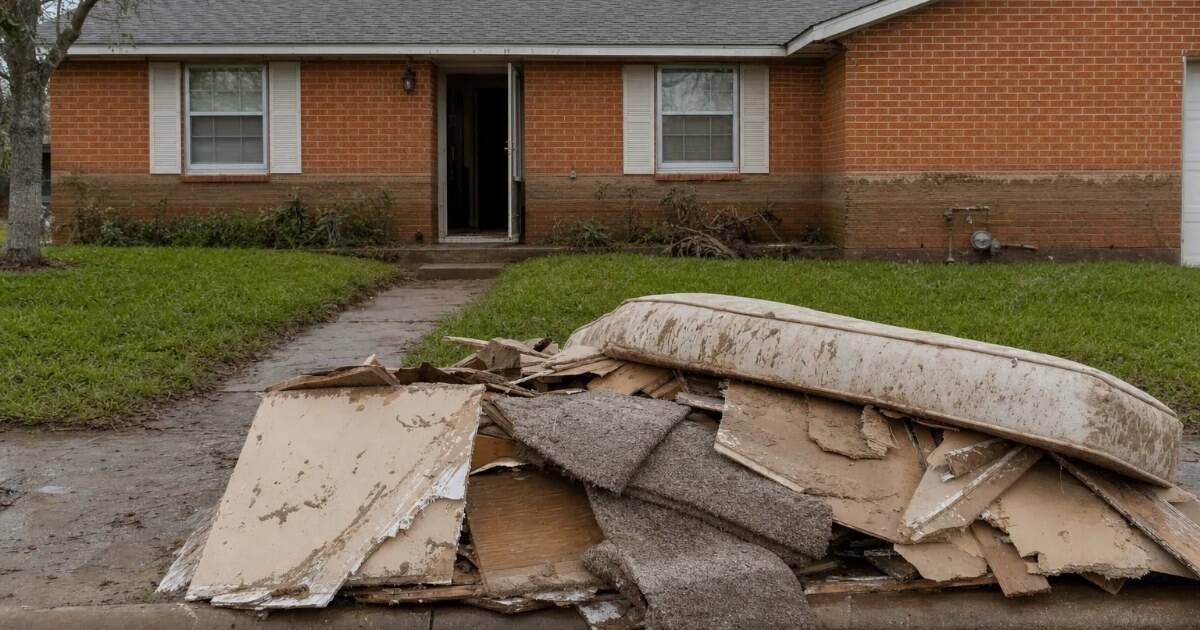
A flood damaged house in Beaumont raises two questions at once. What will the flood policy pay, and will anyone let you put the house back the way it was? The answer to the second one can change the answer to the first, and in my experience owners often find that out after the adjuster has left.
I buy houses in the condition they are in, and after a flood that usually means drywall cut out along the bottom of every wall and a pile at the curb. This post is about one part of the federal flood policy that almost nobody reads: Coverage D, Increased Cost of Compliance, and how it connects to the 50 percent substantial damage rule. I read the federal regulations on eCFR on October 8, 2026, and the quotes below are copied word for word from that text.
What counts as substantial damage on a flood damaged house?
The definition is in 44 CFR 59.1. "Substantial damage means damage of any origin sustained by a structure whereby the cost of restoring the structure to its before damaged condition would equal or exceed 50 percent of the market value of the structure before the damage occurred."
Three parts of that sentence matter more than they look. "Damage of any origin" means it is not limited to flood water. "Market value of the structure" means the building, not the lot. And the same section says substantial improvement "includes structures which have incurred 'substantial damage', regardless of the actual repair work performed." So a house can be substantially damaged even if the owner plans to fix only part of it.
Crossing that line is what brings the community's floodplain rules into play for the rebuild. The flood policy's own list of what it pays for shows what those rules can demand: elevation, floodproofing, relocation or demolition. None of those is a repair.
Who makes the 50 percent call?
The flood policy does not leave it to the owner. For a house that is not a repetitive loss building, Coverage D pays on the 50 percent route only under one condition: "The State or community must have a substantial damage provision in its floodplain management law or ordinance being enforced against the building."
So the first phone call after the water goes down is to the floodplain administrator for the community the house sits in. Ask whether they will make a substantial damage determination, what market value they will use for the structure, and whether you can get it in writing.
What flood insurance pays toward elevation
The Standard Flood Insurance Policy, Dwelling Form, is printed in full in 44 CFR Part 61, Appendix A(1). Coverage D says: "This policy pays you to comply with a State or local floodplain management law or ordinance affecting repair or reconstruction of a building suffering flood damage."
The eligible work is "elevation, floodproofing, relocation, or demolition (or any combination of these activities)." Floodproofing is narrower than it sounds: for homes, the policy limits it to residential buildings with basements that meet FEMA's standards. For an ordinary slab house with no basement, that leaves elevation, relocation or demolition as the work Coverage D will pay for.
The limit is stated plainly. The policy says it will "pay you up to $30,000 under this Coverage D," which "only applies to policies with building coverage (Coverage A)." That payment is in addition to the building coverage you chose, though the two together cannot exceed the maximum the National Flood Insurance Act allows. The policy also says: "We do not charge a separate deductible for a claim under Coverage D."

The two conditions that trip people up
The first is timing. Under the Coverage D exclusions, the policy will not pay "(1) Until the building is elevated, floodproofed, demolished, or relocated on the same or to another premises; and (2) Unless the building is elevated, floodproofed, demolished, or relocated as soon as reasonably possible after the loss, not to exceed two years." The money follows the work. It does not come first.
The second is what it will not pay. Coverage D excludes "The loss in value to any insured building due to the requirements of any ordinance or law," and it excludes code upgrades "e.g., plumbing or electrical wiring, not specifically related to the State or local floodplain management law or ordinance." If the house is worth less because it now has to be raised, Coverage D does not make up that difference.
Where the building claim check goes
Owners with a mortgage are often surprised by this. The policy's Mortgage Clause says any loss payable under Coverage A, the building coverage, "will be paid to any mortgagee of whom we have actual notice ... and you, as interests appear." It adds that the mortgagee "has the right to receive loss payment even if the mortgagee has started foreclosure."
So if you have a mortgage, expect the lender to be paid along with you on the building claim. The policy's Loss Payment section says a loss is payable 60 days after the insurer receives your proof of loss (or within 90 days after the adjuster's report, signed and sworn by you, is filed in place of a proof of loss), once the amount is agreed, set by judgment or set by appraisal. Plan around that window if a sale or a payoff depends on it.
Selling a flood damaged house before it is repaired
Here is the part that matters if you are thinking about selling. Because Coverage D pays only after the elevation, relocation or demolition is done, an owner who sells the house unrepaired has not done the work that triggers it. Whether that coverage can follow the house to a buyer is not something the policy text I read answers. Ask your adjuster in writing before you sign a contract.
A flooded house that cannot be lived in is usually an empty house. In my experience the problems that come when you sell a vacant house, such as break-ins and a yard nobody is cutting, start stacking on top of the flood damage within weeks. That is also most of the reason we buy houses in Beaumont that are still drying out, with the claim file still open.
You will also be filling out the Texas seller's disclosure notice under Property Code 5.008. It asks about "Previous water penetration into a structure on the property due to a natural flood event," whether you have "ever filed a claim for flood damage to the property with any insurance provider, including the National Flood Insurance Program (NFIP)," and whether you have "ever received assistance from FEMA or the U.S. Small Business Administration (SBA) for flood damage to the property." Answer all of them, with dates.
What I would ask for this week
Get the substantial damage determination in writing, with the structure value it used. Ask the adjuster for a written answer on Coverage D, including what happens to it if you sell. Find out who is named on the building claim check. Then decide whether you are elevating, rebuilding or selling, with those three papers in hand.
This is general information and not legal or insurance advice. I am not an attorney or an insurance adjuster.
Sources: 44 CFR 59.1 and 44 CFR Part 61, Appendix A(1) (Standard Flood Insurance Policy, Dwelling Form: Coverage D, Mortgage Clause, Loss Payment), read on ecfr.gov on October 8, 2026; Texas Property Code Section 5.008, read on statutes.capitol.texas.gov on October 8, 2026.


Comments(8)