
Two Small Homes, Two Very Different Questions
I have noticed more interest in smaller homes, backyard cottages, and additional living spaces on family property. Some people want a place for aging parents. Others want a separate home for adult children, a guest cottage, or something smaller to enjoy in retirement.
Two terms that often come up are ADU and tiny home.
They may look similar, but they aren't necessarily the same. If you own acreage in Upstate South Carolina, understanding the difference matters before you spend money.
What Is an ADU?
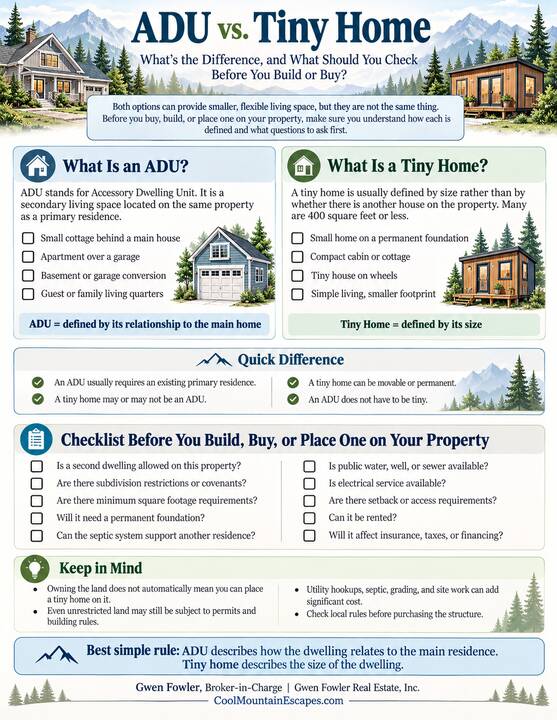
ADU stands for Accessory Dwelling Unit. It is a secondary living space located on the same property as a primary residence. An ADU generally provides independent living facilities, including a place to sleep, a bathroom, and cooking facilities.
Examples include:
A small cottage behind the main house
An apartment above a detached garage
A converted garage with its own living quarters
A basement apartment with a separate entrance
A small home built for parents or adult children
The key distinction is that an ADU is an additional dwelling attached to an existing primary residence. It does not necessarily have to be tiny.
Depending on local regulations, an ADU could have considerably more square footage than what is traditionally considered a tiny home.
What Is a Tiny Home?
A tiny home is generally defined by its size rather than its relationship to another dwelling. The International Residential Code has provisions for tiny houses measuring 400 square feet or less, excluding lofts. Tiny homes can be built on permanent foundations or designed to move.
You might see:
A small cottage on a permanent foundation
A compact one-bedroom residence
A tiny house on wheels
A small cabin designed for simple living
But here is where things can get confusing.
A tiny house on wheels is not automatically considered a legal permanent residence.
Depending on its construction and classification, it could be subject to different requirements from those governing a conventional home. And owning the land doesn't mean you can park a tiny home on it and live there.
Can a Tiny Home Also Be an ADU?
Yes. A 350-square-foot cottage built behind an existing residence could potentially qualify as both a tiny home and an ADU, provided it meets local requirements.
But a tiny home built as the only residence on a vacant lot would not ordinarily be considered an accessory dwelling. The easiest way to remember the difference is:
ADU describes how the dwelling relates to the main residence. A tiny home describes the dwelling's size.
Can You Put Either One on Your Property in Oconee County?
This is where I encourage property owners to do their homework. Before purchasing a tiny home or hiring someone to build an ADU, contact the appropriate county or municipal departments.
Regulations can vary depending on the property's location and whether it is inside city limits.
Here are some questions to ask:
Is a second dwelling permitted on this parcel?
Does the property have restrictive covenants?
Are there minimum square footage requirements?
Will the proposed building qualify as a dwelling under the applicable building code?
Is a permanent foundation required?
Can the existing septic system support another residence?
Is additional water or electrical service available?
Are there driveway, access, setback, or other site requirements?
Can the unit be rented?
Could the additional dwelling affect financing, insurance, or property taxes?
Even unrestricted land may be subject to building codes, wastewater requirements, and other regulations. A property in a subdivision may also have private restrictions that are more limiting than local government rules.
What About Putting a Tiny Home on Family Land?
I expect we will hear this question more often. Perhaps parents own ten acres, and their adult child wants to place a small house nearby. Or someone wants to build a retirement cottage while keeping the original farmhouse.
Those can be wonderful arrangements.
However, family ownership does not eliminate requirements for permits, utilities, access, or wastewater disposal. Another consideration is what happens when the property is eventually sold or inherited.
Who owns the additional dwelling? Can it be separated from the original property? Is there legal access? Are the utilities shared?
Answer these questions before construction, not when someone decides to sell.
Small Homes Do Not Always Mean Small Expenses
I understand the appeal of downsizing. Less space to clean, fewer possessions, and potentially lower maintenance expenses. But the purchase price may be only part of the cost.
Land preparation, grading, foundations, utility connections, septic installation, permits, and driveway improvements can add substantially to the total investment.
A tiny house advertised at an attractive price may not include everything necessary to make it a legal, functional residence.
My Advice Before You Buy or Build
I like the idea of families having more housing options, especially when it lets generations stay close while maintaining independence.
But whether you are considering a tiny home or an ADU, start with the land and the applicable regulations. Find out what is permitted before buying the building.
The most expensive small home may be the one you purchase and later discover you cannot legally place or occupy where you planned.
Smaller living can be a wonderful choice. Just make sure the paperwork and planning are as carefully considered as the house itself.
Gwen Fowler
Broker-in-Charge
Gwen Fowler Real Estate, Inc.
Serving Upstate South Carolina Since 1987
Would you consider a tiny home for yourself, or would you rather have an ADU on your property for family members?


Comments(5)