
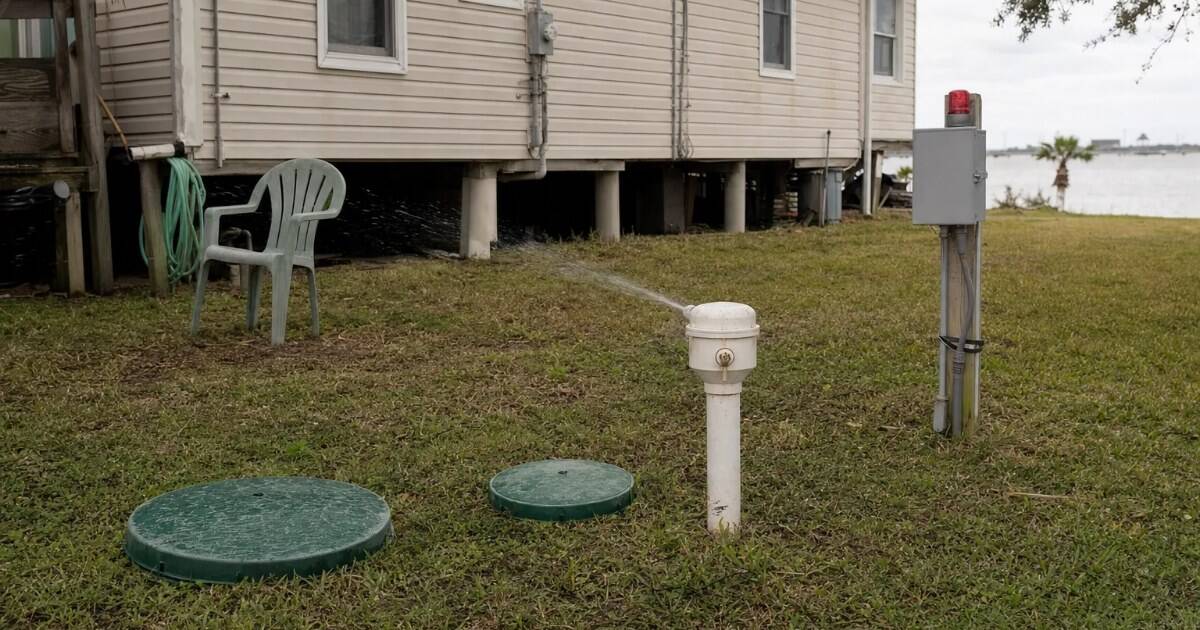
If you are selling a Bacliff house that runs on an aerobic septic system, the buyer is going to ask about it, and the questions are more specific than most sellers expect. An aerobic septic system in Texas comes with a paper trail that a plain septic tank does not: a maintenance contract, test reports, and a tag on the equipment that shows when somebody last checked it.
I wrote about septic systems in general a while back: the county file, the bedroom count, the repair nobody permitted. This post is narrower. It covers the maintenance side only, from the rule that sets it, the Texas Commission on Environmental Quality's on-site sewage rule at 30 Texas Administrative Code 285.7. I read it on October 11, 2026, and the quotes below come from that reading.
Why an aerobic septic system in Texas has a paper trail
Section 285.7(a) puts the duty on the owner's side: "The permit holder shall ensure that the OSSF is properly operated and maintained in accordance with this chapter." OSSF is the rule's word for an on-site sewage facility. For the systems the rule says need one, that duty runs through a maintenance contract.
The list of which systems need a contract sits in a table in a different section, 285.91, and I did not read that table for this post. So I will not tell you which designs are on it. What I can tell you is that the houses I see with a spray head in the yard and a control panel on a post get asked about a contract every time.
The work itself has rules too. Under 285.7(b), the person doing it has to be licensed by TCEQ as a maintenance provider, or registered as a maintenance technician and employed by a licensed provider. And "the maintenance provider must sign all maintenance reports."
The tag on the control panel
The first thing I look at on one of these houses is not paperwork. It is a small tag.
Section 285.7(e)(2) has the maintenance provider put a weather resistant tag on the system at the start of each contract, located "on the outside of the motor cover, control panel, or breaker box." The tag has to name the provider, list the provider's phone number, give the start date of the contract, and be punched or marked with the date of every maintenance check, including visits made because the owner complained.
That tag tells a buyer in ten seconds whether anybody has been out there lately. A tag punched regularly up to this year says one thing. A faded tag with an old start date and nothing after it says another. The buyer's inspector will read it, so read it yourself before anyone else does.

The paper a buyer will ask for
Two documents, mostly.
The contract. Section 285.7(d)(1) sets what it must contain at a minimum: the items it covers, how quickly the provider will respond to an owner complaint, the name of the responsible maintenance provider, how often routine maintenance and testing happen, who maintains the disinfection unit, and the provider's physical business address and phone number. If your contract is missing half of that, it is probably an old form, and a buyer will notice.
The test reports. Under 285.7(e)(1)(B), each report goes "to the permitting authority and the owner within 14 days after the date the test is performed." So copies should exist in two places: your files and the permitting authority's file. If you cannot find yours, the permitting authority that holds your system's records is the place to ask.
The two 30-day windows
Two deadlines in the rule decide whether a system is current or lapsed.
Renewal. After the first two years, "the owner is required to have a new maintenance contract signed and submitted to the permitting authority at least 30 days before the contract expires," unless the owner maintains the system personally. That is 285.7(d)(2).
Termination. If a contract is discontinued or terminated, "the owner shall contract with another maintenance provider and provide the permitting authority with a copy of the new signed maintenance contract no later than 30 days after termination, unless the owner meets the requirements of paragraph (4) of this subsection." That is 285.7(d)(3)(C), and paragraph (4) is the same owner-maintains-it exception noted under renewal. The same subsection has the provider notify the permitting authority in writing at least 30 days before service stops, whether the provider or the owner ends it. So a lapse is something the permitting authority is told about. It does not stay private.
In my experience the common problem is a lapse, not a broken system. The installer stopped calling, nothing smelled, and the contract quietly ran out. When the system has actually failed, the decision changes to repair first or price it in. If that is where you are, the answer to can you sell a house as is in Texas is yes, and the condition of the system becomes part of the price instead of a job you finish before closing.
Selling inside the first two years
Newer systems come with an initial two-year service policy. Under 285.7(c) it runs "for two years from the date the OSSF is first used," and for a new single family dwelling that date is the date of sale by the builder.
If you sell before it ends, 285.7(d)(4)(A) is direct: "If the residence is sold before the end of the initial two-year service policy period, the terms of the initial service policy will apply to the new owner." The policy goes with the house. Hand the buyer the paper for it.
Who is allowed to maintain the system themselves
After the first two years, 285.7(d)(4) gives the owner of a system for a single family residence a choice: "either maintain the system personally or obtain a new maintenance contract." An owner who takes the do-it-yourself route is not subject to the testing and reporting requirements, under 285.7(e)(4).
That choice has a limit that matters at sale. Section 285.7(d)(4)(B) says: "An owner may not maintain an OSSF under the provisions of this section for commercial, speculative residential, or multifamily property." Read plainly, an investor who buys a house to resell it is not in the same position as a family living in it. I am not an attorney, and I have not read any TCEQ guidance on where speculative residential begins, so a buyer in that spot should ask the permitting authority.
For a seller it means this. If you have been maintaining the system yourself, your buyer may not be able to keep doing it that way, and a contract will be near the top of their list. One more line worth knowing, from 285.7(g): "An authorized agent or the commission may inspect an on-site sewage system using aerobic treatment at any time."
What I would gather before selling a Bacliff house on one
Most of this takes an afternoon, and it saves a week of back and forth once a buyer is under contract:
- The current maintenance contract, or a short written note that you maintain the system yourself.
- The last several test reports, or a request to the permitting authority for its copies.
- A clear photo of the tag on the control panel or motor cover.
- Any repair invoices, with the name of whoever did the work.
Gather them even if you plan to sell to a cash buyer. Any buyer, me included, will ask for them, and a seller who has them ready gets a cleaner conversation about price. Bacliff is one of the bay towns where I buy houses with the system as it is, and our sell my house fast in Bacliff page is where that starts.
This is general information and not legal advice. I am not an attorney.
Sources: 30 Texas Administrative Code 285.7 (TCEQ, on-site sewage facilities, maintenance requirements), subsections (a), (b), (c), (d), (e) and (g), read on October 11, 2026 at law.cornell.edu.


Comments(3)